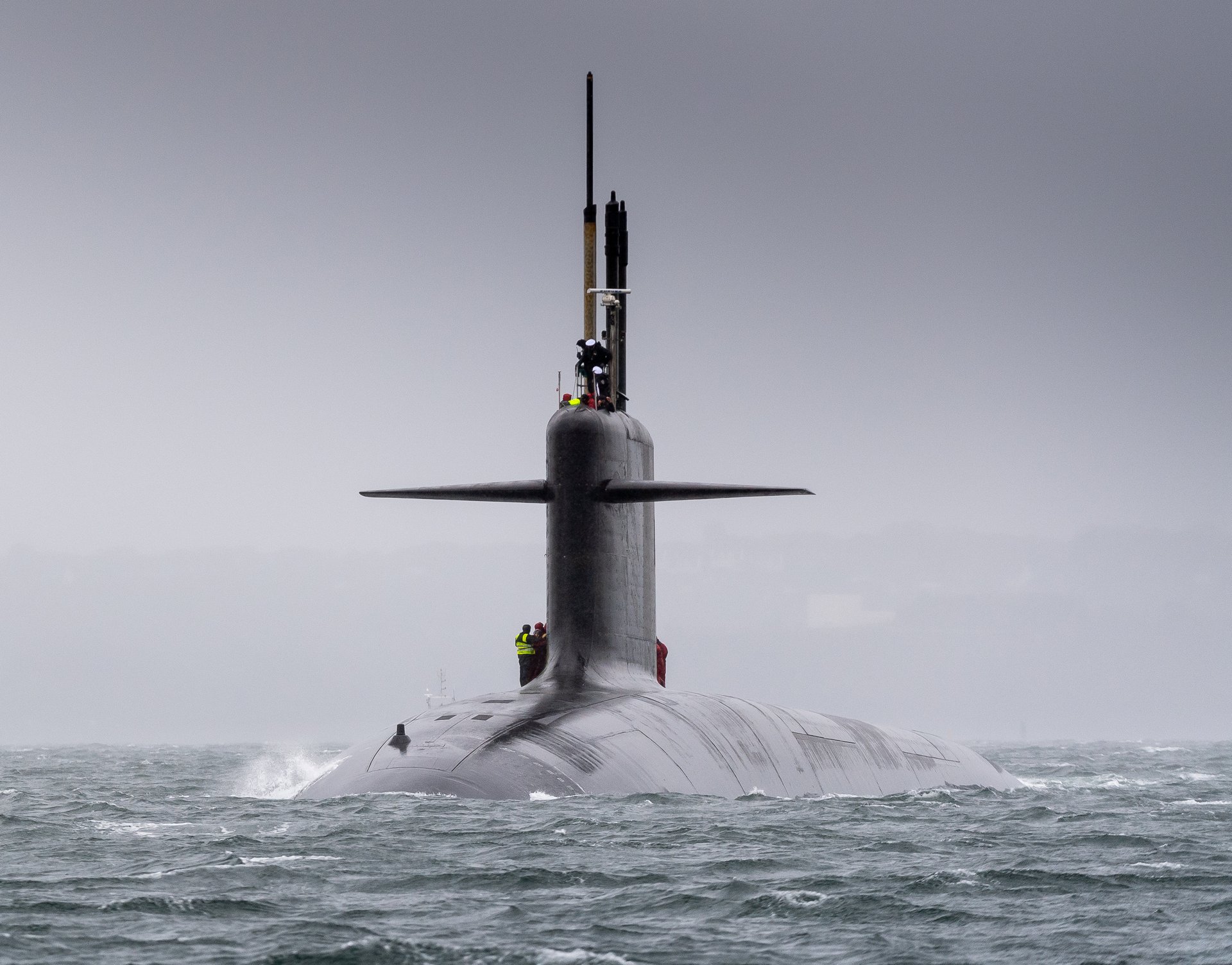
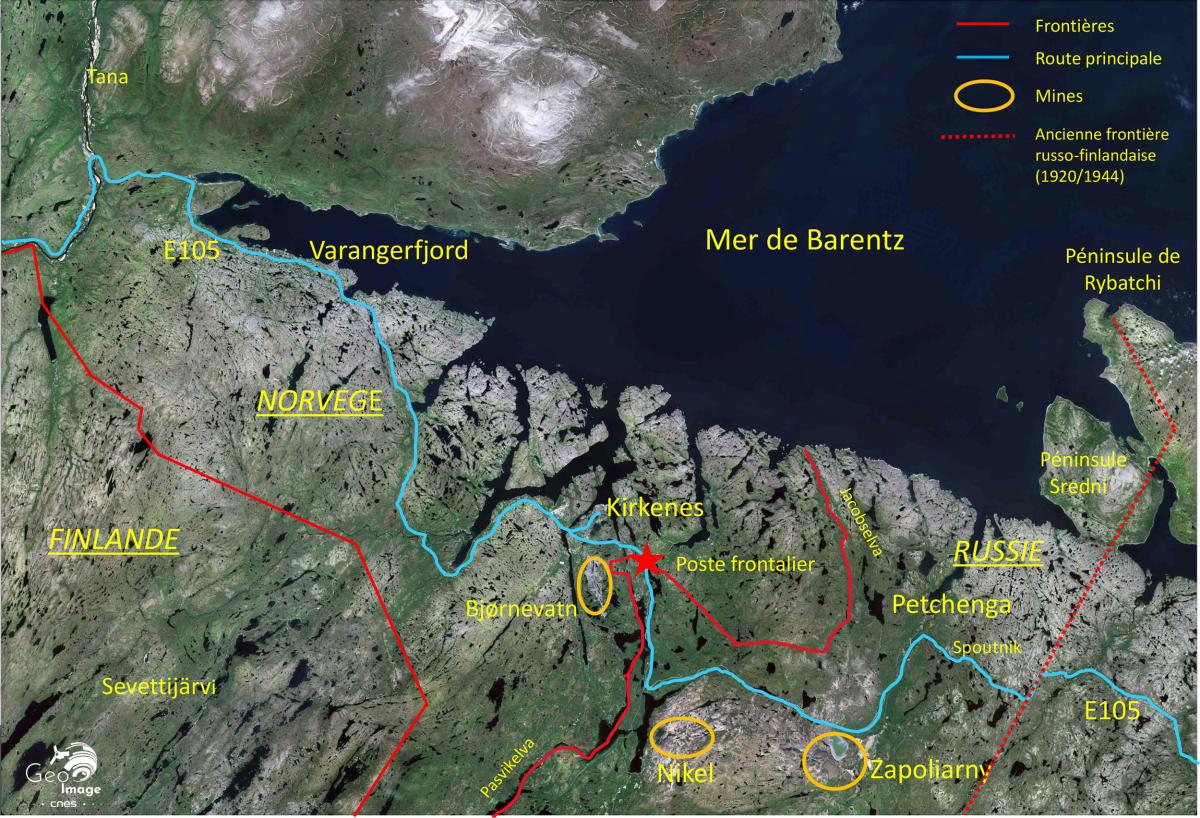
One hundred and ninety-eight kilometres of border separate NorwayNorway
Scandinavian kingdom of about 5.5 million people, a founding member of NATO (1949), not a member of the EU after two referendums (1972, 1994). 198 km border with Russia in the Finnmark, facing the Kola Peninsula where Russia's SSBNs are based. from RussiaRussia
The Russo-Norwegian border runs along the Pasvik river and looks directly onto the Murmansk naval base, the heart of Russia's Northern Fleet and the largest nuclear-submarine complex in the world., roughly the distance between Paris and Le Havre (via Rouen on the A13). But those few kilometres have been enough, since 1949 and Norway's accession to NATONorth Atlantic Treaty Organisation
Military alliance founded on 4 April 1949. Norway is a founding member. 32 member states in 2026, after Finland (2023) and Sweden (2024) joined., to make Oslo think twice before provoking its neighbouring bear. Norway has imposed certain rules on itself: no nuclear weapons on its soil in peacetime, no permanent foreign troops, and no allied manoeuvres within binocular range of MurmanskMurmansk
The largest city north of the Arctic Circle, capital of the Russian oblast of the same name. Home to the Severomorsk base, headquarters of the Northern Fleet and its Bulava-armed SSBNs..
On 27 May 2026, in Paris, Norwegian Prime Minister Jonas Gahr StøreJonas Gahr StørePrime Minister of Norway since October 2021Labour, former Foreign Minister (2005-2012), graduate of Sciences Po Paris. Leads a minority coalition with the Senterpartiet. Architect of the garderingsstrategi, Oslo's security hedging strategy. and Emmanuel MacronEmmanuel MacronPresident of the French Republic since May 2017Re-elected in 2022, in his second and final term. Architect of the « advanced deterrence » doctrine formalised at Île Longue on 2 March 2026. His proposal to Europeanise France's nuclear coverage dates back to the École de Guerre speech of 7 February 2020. signed the Narvik agreementNarvik agreement (27 May 2026)
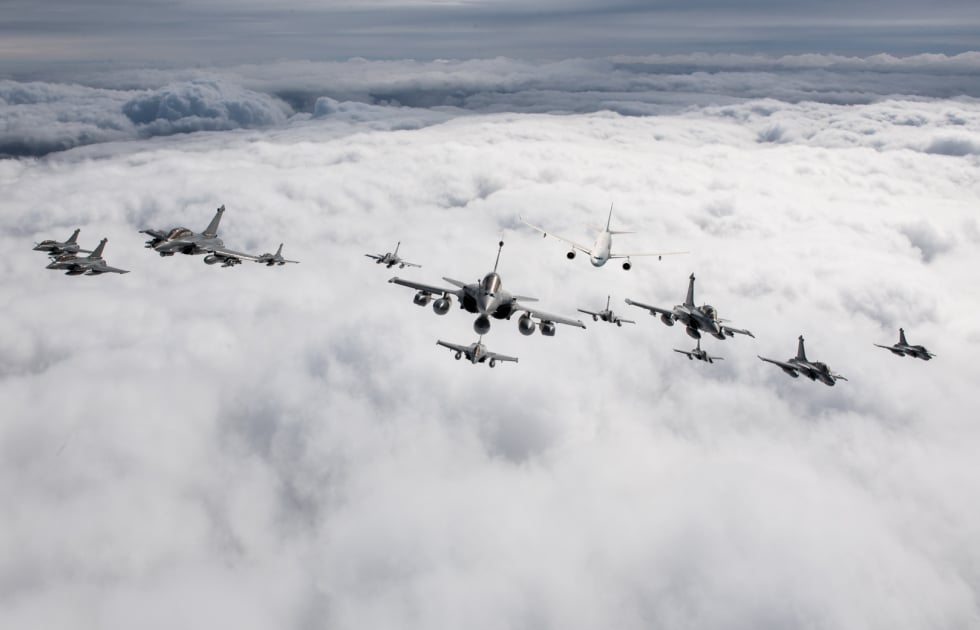
Bilateral Franco-Norwegian mutual-assistance treaty. Includes a clause allowing the temporary deployment of the French Strategic Air Forces on Norwegian soil. The name refers to the Battle of Narvik (May 1940), the first Allied victory of the Second World War., a mutual-assistance pact between Norway and France. Norway thus becomes the ninth country to join the French « advanced deterrence » club. The agreement contains a clause allowing the temporary stationing of the Strategic Air ForcesFAS, Forces aériennes stratégiques
Command created in 1964. Airborne component of France's nuclear deterrent, based at Saint-Dizier and Istres. Operates Rafale B fighters armed with the ASMPA-R (Air-Sol Moyenne Portée Amélioré Rénové) nuclear cruise missile. French aircraft, RafaleRafale B
Dassault Aviation multirole combat aircraft. Only the two-seater Rafale B is certified to carry the ASMPA-R nuclear missile. System range: more than 500 km. The mobile airborne component of France's deterrent. fighters capable of carrying nuclear weapons, on Norwegian soil. On soil that officially does not want them.
Which makes one want to understand what « advanced deterrence » actually is. What it allows, and what it carefully avoids promising.
On 7 February 2020, Emmanuel Macron delivered at the École de GuerreÉcole de Guerre
Joint-services military academy, successor to the École supérieure de guerre founded in 1876. Located in Paris (École militaire). Traditionally the platform for France's major doctrinal defence announcements. a speech that, like the one of 2 March 2026, should have made waves. For the first time in the history of the Fifth RepublicFifth Republic
France's political regime since 4 October 1958. Its Constitution gives the President of the Republic alone the responsibility for the use of nuclear weapons, with no ministerial countersignature or parliamentary authorisation., a President explicitly stated that France's vital interests « now have a European dimension. » Since De GaulleCharles de GaullePresident of the Republic (1959-1969)Founder of the Fifth Republic and of France's nuclear deterrent. In 1960 he ordered the first French nuclear test in the Sahara (Gerboise bleue). His doctrine: a strictly national strike force, independent of NATO, guarantor of sovereignty., French deterrence had been built on a strictly national logic. Allies could of course benefit from it indirectly, but no official text ever assumed any collective dimension.
But only five weeks later, France went into lockdown.
According to Héloïse FayetHéloïse FayetResearcher at IFRI, Deterrence and Proliferation programmeHead of the Deterrence and Proliferation programme at IFRI's Security Studies Center. Sciences Po Paris graduate, former analyst at the French Ministry of Armed Forces. One of the most-cited voices on French nuclear doctrine., from IFRIIFRI, French Institute of International Relations
French think tank founded in 1979 by Thierry de Montbrial. France's leading research institution on international relations. Its Security Studies Center produces most of the French-language research on nuclear deterrence., the 2020 proposals « resulted in modest follow-up, due to unfortunate timing and limited political urgency. » CovidCovid-19
Pandemic declared by the WHO on 11 March 2020. France entered lockdown on 17 March. The 7 February 2020 École de Guerre speech was immediately overshadowed by the health and budgetary emergency. had silenced the continent's political momentum. The speech had been delivered, and stood on record, but found neither echo nor available interlocutors to relay it. The idea existed, then, but was waiting for its moment.
And its moment was war.
In February 2022 the equation changed irreversibly. Russia's « special operation« Special military operation »
Official euphemism imposed by the Kremlin for the invasion of Ukraine launched on 24 February 2022. Using the word « war » has been a criminal offence in Russia since March 2022. », that is the invasion of UkraineUkraine
Eastern European state, independent since 1991. Target of the Russian invasion launched on 24 February 2022. Conflict still ongoing in 2026, having reshaped the entire European security architecture., dragged into public debate concepts that had previously lived only in very closed strategic circles: « nuclear escalation », « deep strikesDeep strikes
Capacity to hit targets far behind enemy lines (command posts, logistical infrastructure, strategic industrial sites). Pivot of the conventional buttressing doctrine proposed by Macron. », « below-threshold deterrenceBelow-threshold deterrence
The full set of military and hybrid actions taken below the nuclear-use threshold, but aimed at deterring escalation. Central concept of the Franco-German declaration of 2 March 2026. ». As Thomas GomartThomas GomartDirector of IFRI since 2015Historian and political scientist, Russia specialist. PhD in history (Paris-IV Sorbonne), author of several reference works on contemporary geopolitics, including L'Affolement du monde (2019) and Guerres invisibles (2021). writes in the Revue Études, Europe finds itself faced with « a trivialisation of nuclear rhetoric by Russian officials and the firing of dual-capable missiles close to European borders. »
In parallel, the return of Donald TrumpDonald TrumpPresident of the United States since January 2025Second term (2025-2029) after that of 2017-2021. Has repeatedly questioned NATO's Article 5 and the American commitment to Europe. Unwitting catalyst of European strategic autonomy. to the helm of the world's foremost power, and his pronouncements about his view of NATO, sow another kind of doubt, probably deeper because it comes from inside. In 2025, approval of American leadership in NATO member states fell to 21%, according to GallupGallup
American polling institute founded in 1935. Its annual U.S. Global Leadership Project survey has measured approval of American leadership in more than 130 countries since 2007., a 14-point drop in a single year. The American umbrella still exists, but Europeans are asking for the first time whether it will actually be opened when the rain truly comes. Emmanuel Macron, for his part, wields words with phlegm: « The field of rules has become a field of ruins. »
A speech at the head of a discreet architecture
2 March 2026 is the visible culmination of diplomatic work that had been quietly building for months.
In January 2025, France and Norway signed a letter of intent on bilateral defence cooperation, discreet and technical, but laying the first stone of what would become the Narvik agreement. And it does not stand alone: in six months, Oslo has multiplied its signatures, with the Lunna House agreementLunna House agreement
Norwegian-British bilateral treaty signed on 4 December 2025 in the Shetlands. Framework for cooperation on security, defence and civil resilience. The Lunna House site was once the base of the « Shetland Bus », the Royal Navy operation that supplied the Norwegian resistance during the Second World War. concluded with the United Kingdom on 4 December 2025, the Hansa arrangementHansa arrangement
German-Norwegian framework signed on 14 February 2026 in Berlin, covering naval, submarine and defence-industrial cooperation. The name refers to the medieval Hanseatic League of North Sea and Baltic ports. signed with Germany on 14 February 2026, and then Narvik with France on 27 May. A strategy that Norwegians themselves call garderingsstrategiGarderingsstrategi
Literally « hedging strategy » in Norwegian. Oslo's unofficial doctrine: multiply bilateral security agreements so as never to depend on a single guarantee. A Cold-War practice reformulated after Russia's invasion of Ukraine., a hedging strategy that ensures their security never rests on a single guarantee.
In July 2025, Emmanuel Macron and Keir StarmerKeir StarmerPrime Minister of the United Kingdom since July 2024Labour, former Director of Public Prosecutions. His Northwood declaration with Macron (10 July 2025) marks the deepest Franco-British nuclear rapprochement since the Lancaster House treaties (2010). signed at NorthwoodNorthwood
Royal Navy's Permanent Joint Headquarters, in north-west London. Also home to NATO's Maritime Command. A highly symbolic venue for a nuclear declaration., on 10 July, the declaration that created the Franco-British Nuclear Steering GroupFranco-British Nuclear Steering Group
Permanent consultative body on nuclear strategy, created on 10 July 2025. Provides for joint SSBN patrols, R&D sharing, and coordinates the doctrines of Europe's only two nuclear powers.: permanent consultations on nuclear strategy, joint ballistic-missile submarineSSBN, Ship Submersible Ballistic Nuclear
Nuclear-powered combat submarine carrying intercontinental ballistic nuclear missiles. France operates four of them (Triomphant class), all based at Île Longue. The United Kingdom also operates four (Vanguard class). patrols, sharing of R&DR&D, Research and Development
Here refers to the modernisation programmes for nuclear warheads, delivery vehicles (French M51 missiles, British Trident) and command-and-control systems.. The group held its first meeting in Paris in December 2025.
On 26 January 2026, Mark RutteMark RutteSecretary General of NATO since October 2024Former Dutch Prime Minister (2010-2024), liberal. Known for his proximity to Washington and his hostility to any European strategic autonomy perceived as competing with the Atlantic framework., NATO Secretary General, warned Europeans against pursuing strategic autonomy outside the Atlantic framework. Thirty-five days later, from the SSBN base at Île LongueÎle Longue
Peninsula in the harbour of Brest (Finistère, Brittany). Operational base of France's Strategic Ocean Force (FOST) since 1971. Home to the four French SSBNs and their M51 missiles. The most heavily protected military site in France., Macron announced « advanced deterrence ».
Three key concepts
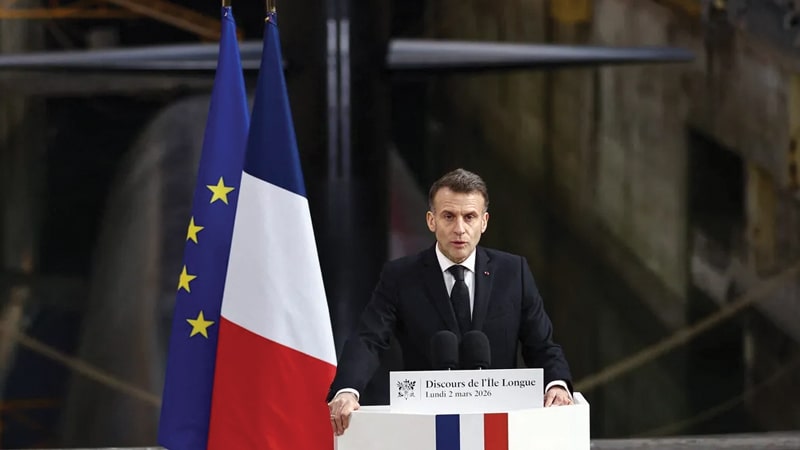
« Advanced deterrence » rests on three pillars that structured Emmanuel Macron's Île Longue speech.
The first is raising the arsenal. « Raising our arsenal is essential. » This means abandoning the famous doctrine of « strict sufficiencyStrict sufficiency
French doctrinal principle that the nuclear arsenal must be kept at the lowest level compatible with deterrence. Formalised by Jacques Chirac in 1996, it capped the declared arsenal at 290 warheads. ». That doctrine had kept the declared arsenal at 290 nuclear warheads. Macron justifies the shift by « the evolution of our competitors' defences, the emergence of regional powers, the possibility of coordination between adversaries, and the risks linked to proliferationNuclear proliferation
Acquisition of nuclear weapons by new states. In 2026, nine states possess nuclear weapons: United States, Russia, United Kingdom, France, China, India, Pakistan, Israel, North Korea. Iran remains a pivotal case. »: all of this, he says, has made the current trajectory inadequate. It is not, he insists, about entering an arms race, « it would be pointless to claim entry into a costly bidding war », but about preserving what he calls « a guaranteed power of destructionGuaranteed power of destruction
French variant of the Anglo-Saxon concept of Mutual Assured Destruction (MAD). The guarantee that, in the event of nuclear attack, France would retain enough second-strike capability to inflict unacceptable damage on the aggressor. in the dangerous, shifting and proliferating environment. » As for the numbers behind that increase: « we will no longer communicate the figures of our nuclear arsenal. » Opacity about the stockpile is now claimed as a method, strategic ambiguityStrategic ambiguity
Doctrine of deliberately leaving doubt about one's capabilities, doctrines or red lines, so as to complicate an adversary's calculation. Israel is the classic nuclear example; France partly rallied to it on 2 March 2026. elevated to a deterrent tool in its own right.
The second pillar is buttressing. The speech makes clear that the Europeanisation of nuclear coverage cannot function alone: it must « lean, without restriction of access, on resized and shared European conventional capabilities. » Concretely, this means pooling capabilities in the upper tiers of conventional armament, around three domains Macron names precisely: early warning to detect threats, broadened air defence to ward them off, deep strike to act on them. It is also what the Franco-German declaration signed the same day makes operational: Paris and Berlin commit to strengthening their capacity to manage escalation below the nuclear threshold. Buttressing therefore does not just mean that the nuclear extends, but that the conventional must follow to make it credible.
The third pillar is European association. Until now, France logically assumed that its deterrent protected its neighbours indirectly, without ever formalising it politically. That step is taken by the Île Longue speech, and it is now an explicit offer, with concrete modalities. Eight countries accepted the framework from March 2026: the United Kingdom, Germany, Poland, the Netherlands, Belgium, Greece, Sweden and Denmark. Norway joined the arrangement two months later. In practical terms, partners are invited to contribute to escort missions for nuclear raids, to temporarily host Rafale fighters of the Strategic Air Forces on their soil, to make the extension of the French umbrella physically visible across the continent. The goal is to build an « archipelago of forcesArchipelago of forces
Image used by Macron to describe the continental dispersion of French capabilities. The aim: to complicate the planning of an adversary's pre-emptive strike by multiplying the temporary deployment bases. », a continental dispersal that « will complicate the calculation of adversaries and give this advanced deterrence considerable value. »
What the speech rules out
This is where the detail really matters. Because advanced deterrence is not only about what it does, but above all about what it explicitly refuses to do.
« I would rather say it straight away: there will be no sharing of the ultimate decision, nor of its planning, nor of its implementation. Under our Constitution, it belongs to the President of the Republic alone, accountable to the French people. »Emmanuel Macron, Île Longue, 2 March 2026
Translated, this means: the partners are in the arrangement, but they have no say in the firing decision, France still has no intention of joining NATO's NPGNPG, Nuclear Planning Group
NATO's nuclear planning group, created in 1966. Forum where the 31 allies (excluding France) discuss the doctrine and nuclear posture of the Alliance. France has stayed out of it since leaving the integrated command in 1966, despite its partial return in 2009., and there will be no permanent deployment of French nuclear weapons on allied soil. There will be no replication of the American « nuclear sharingNuclear sharing
NATO arrangement under which the United States permanently deploys around 100 tactical B61 nuclear bombs on the soil of five allied countries (Germany, Belgium, Italy, the Netherlands, Turkey). Aircraft from those countries are certified to carry them, but the firing code remains American. » model, in which countries like Germany or Belgium host American B61B61
American tactical nuclear bomb with variable yield (0.3 to 340 kilotons depending on the version). The latest version (B61-12) is being deployed. About 100 are stationed in Europe under the nuclear-sharing arrangement. bombs and take part in their operational implementation.
This is precisely where the choice of word takes on its full weight. France does not do « extended deterrenceExtended deterrence
Formal nuclear guarantee granted by a nuclear power to a non-nuclear state. The American model towards NATO, Japan and South Korea. Involves a legal commitment of nuclear retaliation in the event of an attack on the ally. » (the American extended deterrence, which is an explicit guarantee given to third parties) but rather « advanced deterrence », a posture projected geographically without an explicit legal guarantee. The whole doctrine therefore hinges on the choice of that single word.
« A posture projected geographically, without any explicit legal guarantee. »The definition of advanced deterrence, against American extended deterrence
The paradox
Since De Gaulle, France has built its nuclear doctrine on one central conviction: no external guarantee is credible enough to justify giving up one's own bomb. The logic being that an ally, even the most loyal one, will always weigh the cost of nuclear conflict on its own territory, its own population, before pulling the trigger to defend another country. That is deeply human and rational, and it is why France invested tens of billions in a sovereign deterrent.
And yet, Paris is now offering nine European countries exactly what France itself had judged inadequate, an external guarantee, offered by a power whose politics (domestic or foreign) they do not control, and whose final decision they cannot influence. The irony is total, and it has not escaped analysts: this is precisely the reasoning, that an external guarantee is never fully credible, that pushed French decision-makers to develop an autonomous nuclear capability.The paradox is structural: France is offering its neighbours a protection that it judged, in 1960, would never be credible enough for itself to settle for.
This paradox is in fact a structural reality shared by all systems of nuclear guarantee. The United States has been living with it since 1949. It is not a defect of the arrangement, it is its very nature.
What France gets out of it
Concretely, deploying Rafale fighters on allied territory, even temporarily, improves the survivabilitySurvivability
Capacity of a nuclear force to survive an enemy pre-emptive strike and retaliate. A conceptual pillar of deterrence. Depends on dispersion, mobility and stealth of the delivery vehicles. of the French arsenal. If the SSBNs are the backbone of the second strikeSecond strike
Capacity to inflict nuclear retaliation after sustaining an enemy first strike. Mainly guaranteed by undetectable SSBNs on permanent patrol. This is what makes deterrence credible., aircraft dispersed across Europe complicate the scenario of a Russian pre-emptive strike (for instance) on the French nuclear capability. This is what is called strategic geometry. Poland in particular « provides the main geographic footprint for operations », according to the analysis published by the BeHorizonBeyond the Horizon ISSG
Independent think tank based in Brussels, founded in 2017. Specialised in geopolitics, international security and defence. Reference analytical output on post-2022 European defence arrangements. think tank on the day after the speech, 4 March 2026.
France has also been, since 2023, the main naval contributor to the Atlantic Alliance, with 700 to 750 days at sea each year devoted to NATO operations, compared with 214 in 2021. More than 70% of this engagement is focused on the northern flankNorthern flank
In NATO parlance, designates the North Atlantic and Arctic theatre: Norwegian Sea, Barents Sea, GIUK Gap (Greenland-Iceland-UK), where Russia's Northern Fleet SSBNs operate.. This is no stranger to Norway joining the arrangement. Paul Van HooftPaul Van HooftSenior analyst at RAND EuropeResearcher in nuclear strategy and grand strategy. Co-authored, with Héloïse Fayet and others, the 2025 reference study European Nuclear Deterrence and Donald Trump in IISS's Survival journal., analyst at RAND EuropeRAND Europe
European branch of the RAND Corporation, American think tank founded in 1948. Offices in Cambridge and Brussels. Research on defence, security and public policy, largely funded by allied governments., notes that « these arrangements are likely to expand Paris's influence in Europe, something the President's potential successors, on the far left or the far right, might not want to abandon. » If the arrangement takes root, it will be hard for any ideologically opposed successor to dismantle.
What partners get, and what they don't
They get a strong political signal towards Moscow, joint exercises, dialogue on threat scenarios, participation in a security architecture at no nuclear cost. And the effect was immediate: in the days following 2 March, partner reactions were overwhelmingly positive, coordinated, and public. Not everything was unanimous, though: Italian commentators complained about being left out, and the Norwegian press split, with some editorialists going as far as to call it a « historic mistakeSeveral Norwegian editorialists, notably in Aftenposten and Klassekampen, denounced a break with the 1957 doctrine on the non-presence of nuclear weapons on national soil. ».
They get no mechanism to activate French deterrence. No shared decision-making body guarantees that their reading of the threat will weigh on Paris's calculations. Furthermore, several of them, Germany, Belgium and the Netherlands, already take part in American nuclear sharing within NATO; the question of compatibility between the two arrangements remains, for now, completely open. This is one of the three gaps identified by researcher Monika SusMonika SusProfessor at the Hertie School (Berlin)Researcher in EU foreign and security policy, affiliated with the European University Institute in Florence. Specialist in European decision-making dynamics in defence and the Europeanisation of national policies., along with the lack of any guarantee that allied threat perception will influence Paris, and the absence of concrete contribution mechanisms.
Then there is a more fundamental fragility, and it is political. The arrangement rests entirely on the will of a single person, in a single country. The French presidential election in 2027 could therefore be enough to change the nature of the arrangement, or to bury it silently.
What advanced deterrence opens up is a Europeanisation of the posture: France now fully assumes that its protection extends to the continent. Yet she remains the sole master of the final decision, staying at the very edge of what a sovereign nuclear state can offer without surrendering its sovereignty itself. One question remains: will operational reality keep pace with political rhetoric? The French nuclear arsenal was designed for massive strategic strikes, guaranteed destruction, not for a graduated strategy. Yet the most likely scenarios of a confrontation with Russia are scenarios of limited coercionLimited nuclear coercion
Use or threat of use of low-yield tactical nuclear weapons, to signal resolve and force the adversary to back down, without triggering massive escalation. Official Russian doctrine: « escalation to de-escalate »., signalling, controlled escalation. And these flexible options, France does not really have, or at least not yet. As researcher Lauren SukinLauren SukinAssociate Professor, University of OxfordJohn G. Winant Associate Professor in U.S. Foreign Policy, Nuffield College, Oxford. PhD from Stanford. Specialist in nuclear guarantees, her work shows how « over-credible » guarantees can paradoxically backfire on allies. sums it up, the French arsenal, optimised for catastrophic retaliation rather than flexible options, may not be the best suited to respond to limited nuclear coercion, the most plausible scenario in today's world.
Norway as a full-scale test
Back to Narvik. The name refers to the Battle of NarvikBattle of Narvik (April-June 1940)
First Allied victory of the Second World War. Franco-British forces (notably the 13th Demi-Brigade of the French Foreign Legion) and the Norwegian resistance retook the strategic port of Narvik from German troops, before evacuating in the face of the fall of France., in May 1940, the first Allied victory of the Second World War, won thanks to Franco-Norwegian cooperation. The choice is deliberate, and obviously symbolic.
Bruno TertraisBruno TertraisDeputy Director of FRSDeputy Director of the Foundation for Strategic Research. French reference on nuclear deterrence, author of many books including La France et la dissuasion nucléaire (La Documentation française). Consultant to NATO, the French Ministry of Armed Forces, and several international institutions. noted, a quarter of a century ago, that « the North is traditionally and implicitly considered "Anglo-Saxon" territory and is not on the French strategist's radar. » What Støre signed on 27 May therefore represents a real shift of that radar.
Norway has the advantage of being a textbook case for testing what advanced deterrence can do under the most constraining conditions. As mentioned, she refuses nuclear weapons on her soil in peacetime, a line set as early as 1957; she has 47 military sites open to US forces; she is in the British-led Joint Expeditionary ForceJEF, Joint Expeditionary Force
Joint expeditionary force under British command, created in 2014. Ten member states (UK, Netherlands, Denmark, Norway, Estonia, Latvia, Lithuania, Finland, Sweden, Iceland). Rapid-reaction framework focused on the northern flank.. She has just approved an additional 60 billion euros over twelve years for defence, putting her above 3% of GDPGDP, Gross Domestic Product
Economic indicator measuring the value of production within a country. NATO's 2014 and 2024 commitments set a defence spending floor at 2%, then 3% of GDP. when Ukraine aid is included. It is therefore a country multiplying its security ties, faithful to its garderingsstrategi, which holds that its security must never rest on a single guarantee.
What this changes, or doesn't, vis-à-vis NATO
France takes care to present its advanced deterrence as « a distinct but complementary effort to NATO's nuclear effort. » Alongside this, the Franco-German declaration of 2 March adds that cooperation is « complementary, not substitutive » to the Atlantic framework. The word « complementary » returns with an insistence that eventually reveals something about the anxiety of having to repeat it.All the French rhetoric of 2 March is calibrated not to upset Washington or Rutte. The repetition of « complementary » functions as a pre-emptive protest of Atlantic allegiance.
If the goal is to improve deterrence at continental scale, logic would call for coordination at NATO level, with all partners, in the common framework that already exists. Yet France has refused, since its creation, to join the Nuclear Planning GroupNATO's Nuclear Planning Group (NPG)
Body created in 1966 to discuss the Alliance's nuclear policy. All allies sit on it, except France, which left the integrated command the same year and has never returned, even after the partial reintegration of 2009., the very body designed for that. So she negotiates bilaterally with each country, one by one, while carefully avoiding the multilateral framework that real articulation would require. This is coherent with the historical doctrine of absolute independence, but less coherent with the European ambition on display.
The major absentees from the 2 March speech are the Baltic statesBaltic states
Estonia, Latvia, Lithuania. Former Soviet republics independent since 1991, NATO and EU members since 2004. Combined population: about 6 million. The states most exposed to a Russian military action.. Their absence does not mean they do not benefit from the continental coverage of the doctrine: French logic does not name protected allies, it affirms that French vital interests « cannot be confined to the mere tracing of our national borders », which works generally in their favour. Estonia, Latvia and Lithuania however do not benefit from any of the advantages guaranteed to the nine countries of the framework, even though they are probably the NATO member states most exposed to a Russian military action. They have no strategic depth, a common border with the exclave of KaliningradKaliningrad
Russian exclave on the Baltic, seized from Germany in 1945. Home to the Baltic Fleet, Iskander missiles with nuclear capability, and major electronic-warfare systems. Militarily monitors the entire Baltic flank. and Belarus, with the Suwalki corridorSuwalki corridor
About 100 km strip of territory between Kaliningrad and Belarus, along the Polish-Lithuanian border. The only land link between the Baltic states and the rest of NATO. Considered the most sensitive point of the European eastern flank. as their only land link to the Alliance. So in an arrangement supposedly designed to respond to the Russian threat, the states for which this threat is most concrete are left on the doorstep. This blind spot does not mean it is an oversight: it simply means the system as currently built cannot see them without changing its posture.
The 2027 election
Advanced deterrence is one man's architecture, built at the end of his term on fragile institutional foundations. The system remains « one bad election » away from losing its credibility.
Concretely, if Jordan BardellaJordan BardellaPresident of the Rassemblement National since 2022Successor to Marine Le Pen at the head of the RN. Potential candidate for the 2027 French presidential election. The RN has historically defended a strictly national reading of deterrence, hostile to any Europeanisation of the decision., or someone like him, enters the Élysée, debates over proliferation in countries like Germany or Poland could reopen for the first time in decades. That would be the paradoxical effect that advanced deterrence was meant to avoid: pushing countries the doctrine wanted to reassure towards national or transatlantic alternatives. Nevertheless, if the cuttings of the bilateral agreements really take root, if the exercises take place, if structures are built, then institutional interests will become hard to uproot. Emmanuel Macron's successors will inherit an architecture they will maintain, probably not out of conviction, but out of inertia and acquired influence. The goal is therefore not so much to convince successors as to leave them a situation in which rolling back would cost them more than moving forward.Classic « lock-in » mechanics: create exit costs high enough to discourage any reversal, even from ideologically hostile actors.
What Støre actually signed
One last return to Narvik. Jonas Gahr Støre signed an agreement that, in essence, says: if something serious happens, France and Norway will consult; France may deploy its aircraft on Norwegian territory; and the Norwegian policy of not hosting nuclear weapons continues to apply in peacetime. What will actually be activated, in a crisis, depends entirely on a French president whom Oslo does not choose, and whose innermost calculations Oslo cannot possibly know at the very moment the fateful decision comes.
It is a lot and very little at the same time.
It is a lot because France is a real nuclear power, because her submarines patrol the Alliance's northern flank for 70% of their NATO activity, and because the signal sent to Moscow through this accession to the framework is anything but trivial. But it is little because that deterrence works on its credibility, and credibility is the very weak spot that this arrangement cannot guarantee, by construction.
Advanced deterrence is a real shift, but a shift of form, not of substance. It expresses differently a doctrine that remains fundamentally sovereign and national.
- Speech by the President of the Republic on French nuclear deterrence, Île Longue, 2 March 2026. elysee.fr
- Speech by the President of the Republic at the École de Guerre, 7 February 2020. elysee.fr
- Fayet, Héloïse. Rethinking French Deterrence in Light of the War in Ukraine. IFRI, 2024. ifri.org
- Fayet, H., Futter, A., Kühn, U., Kulesa, Ł., Van Hooft, P., Bruusgaard, K.V. « European Nuclear Deterrence and Donald Trump ». Survival, février-mars 2025. iiss.org
- Gomart, Thomas. « Europe, War and Deterrence ». Revue Études, 2024. revue-etudes.com
- Tertrais, Bruno. La France et la dissuasion nucléaire. La Documentation française, updated editions. frstrategie.org
- Sukin, Lauren. « Credible Nuclear Security Commitments Can Backfire ». Journal of Conflict Resolution, Stanford / Oxford. laurensukin.com
- Sus, Monika. Work on EU foreign and security policy. Hertie School / EUI. hertie-school.org
- Beyond the Horizon ISSG. Analysis of the Île Longue speech, 4 March 2026. behorizon.org
- Franco-British Northwood declaration, Nuclear Steering Group, 10 July 2025. gov.uk
- Narvik agreement (France-Norway), 27 May 2026. Joint communiqué. regjeringen.no
- Gallup. Rating World Leaders 2025. news.gallup.com
- Mark Rutte, NATO address, 26 January 2026. nato.int
- Ravet-Salmon, Timothée. « Norway is in the EU. She does not know it yet. » Tiravet, May 2026. tiravet.fr