On 25 July 2026, above the pine forests of LacanauLacanau
Commune in Gironde where the A400M carried out its first real-world drop under operational conditions on 25 July 2026, over a territory already ravaged by the megafires of 2022., a military transport aircraft dropped twenty tonnes of water onto a wall of flames—roughly the volume of a municipal swimming pool, released all at once from an altitude of four hundred metres. The aircraft in question, the A400MA400M
Military transport aircraft built by Airbus, designed for paratrooping and transporting armoured vehicles. Since 2026, an experimental kit has enabled it to drop up to twenty tonnes of water on wildfires., was originally designed to parachute troops and transport armoured vehicles. Yet, it was recently equipped with a water-bombing kitWater-bombing kit (A400M)
Equipment added to the hold of the A400M, developed by Airbus alongside the civil defence authority, which temporarily transforms the military aircraft into a water bomber without any permanent structural modification., the culmination of five years of discreet testing conducted far from the public eye by AirbusAirbusEuropean aerospace corporationManufacturer of the A400M and developer of the water-bombing kit tested in Lacanau in partnership with the French civil defence authority. and the French civil defence authoritySécurité civile (DGSCGC)
General Directorate of Civil Security and Crisis Management, a department of the Ministry of the Interior that oversees France's aerial firefighting fleet..
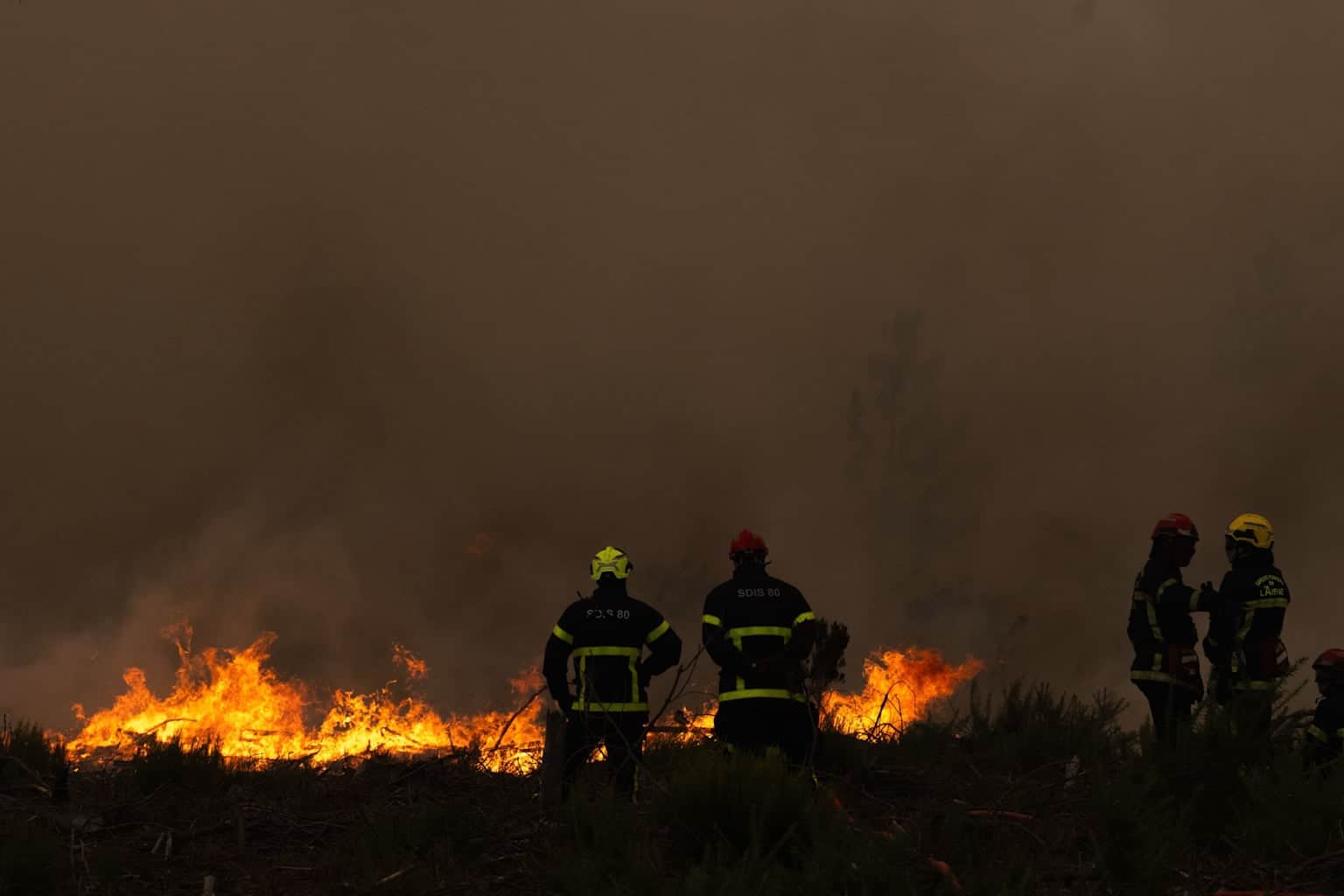
That very same day, the Ministry of the Interior released a figure that alone set the scene: 98,000 hectares burnt since January, surpassing the total for the entirety of 2022. That these two pieces of information emerged simultaneously is less a matter of coincidence than a faint signal becoming glaringly obvious. One does not deploy a prototype in real-world conditions after five years of trials when standard equipment is still sufficient to hold the line.
This doctrine thus warrants closer examination. It relies on a fleet whose average age exceeds thirty years, on a Canadian supplier holding a monopoly, and on budget lines that have just surged by over 400% following years of underinvestment. Understanding why France has resorted to mobilising a warplane to extinguish its forests requires looking a little further back than the summer of 2026.
Twelve aircraft, thirty years, and a delayed promise
In 2020, the civil defence authority retired seven Tracker aircraftTracker aircraft
Their precipitate withdrawal created a major initial capability gap for the French civil defence authority. from its fleet following severe incidents and a lack of spare parts. No aircraft were immediately built to replace them, and the fleet found itself operating with a reduced margin of manoeuvre at the very moment when summers began to grow increasingly severe.
Two years later, on 28 October 2022, Emmanuel MacronEmmanuel MacronPresident of the RepublicPresident of the French Republic who announced on 28 October 2022 the replacement of the twelve Canadair CL-415s with sixteen new aircraft before 2027, an objective since postponed to 2033. announced that the twelve Canadair CL-415sCanadair CL-415
Amphibious aircraft built by Canadair and later Bombardier, capable of scooping six tonnes of water in twelve seconds from a body of water. The historic pillar of aerial firefighting in France since the 1990s. would be replaced by sixteen new aircraft before the end of his term, and thus before 2027. The LOPMILOPMI
French legislation (Law for the Orientation and Programming of the Ministry of the Interior) that enshrined the 2022 presidential commitment to renew the Canadair fleet, transforming a political announcement into a legislative objective. adopted the commitment almost verbatim the following year, cementing into law what had previously been merely a presidential pledge. The official objective was set: a renewed, larger fleet in under five years.
The summer of 2022 soon followed, with over 70,000 hectares burnt—a record that compelled the government to requisition private helicopters to support an exhausted fleet. The Court of AuditCourt of Audit
French independent institution tasked with auditing the use of public funds. Its 2022 report on the civil defence aerial fleet condemned the lack of strategic vision and the absence of a multi-year operational contract. examined the case the same year, and its verdict, delivered in July, left little room for interpretation: the civil defence authority lacked any operational contract, had no multi-year vision for its investments, and managed its aerial resources unit with a governance instability that caused concern even within the ranks of the administration.
The purchase agreement for the first two DHC-515sDHC-515
New generation of amphibious water bomber produced by De Havilland Canada, successor to the CL-415. Offers slightly superior payload capacity, but its delivery schedule has been heavily delayed compared to initial announcements., the new generation of Canadair, was not signed until 9 August 2024, following negotiations that began in 2021 with a Canadian manufacturer holding a monopoly. Delivery is slated for 2028, a full decade after the aircraft was first presented by De Havilland CanadaDe Havilland CanadaCanadian aerospace manufacturerThe sole global manufacturer of amphibious water bombers in the CL-415 and DHC-515 class, holding a monopoly in this niche market.. Between the promise of 2022 and the contractual reality of 2024, two years evaporated without a single additional aircraft joining the tarmac at Nîmes-GaronsNîmes-Garons (LFTW)
French civil defence airbase in the Gard department, the anchor point for the national fleet and a benchmark site for the deployment of RescEU aerial assets in Southern Europe.. This does not mean that nothing was done. It means that the State acted belatedly within an already saturated industrial environment.
Three aircraft for a single doctrine
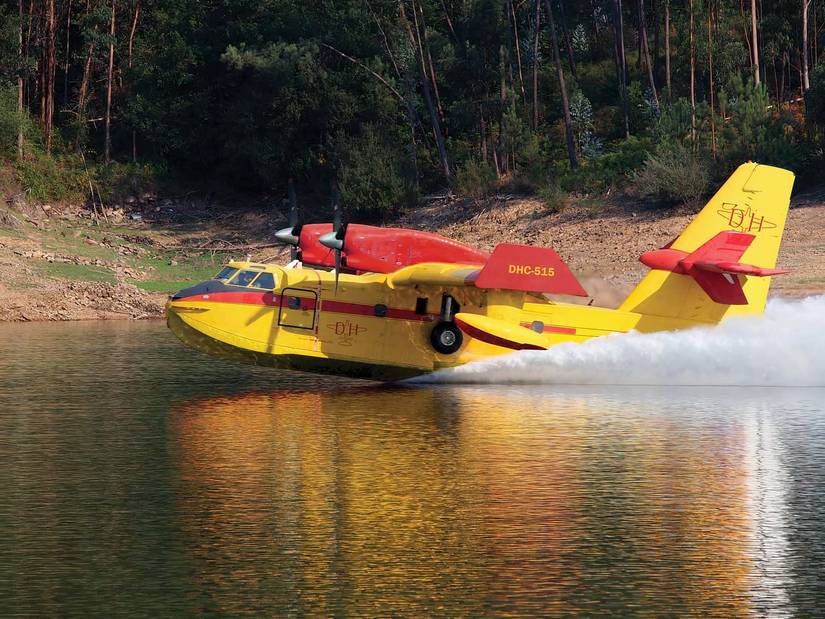
The Canadair CL-415 scoops water. This is what distinguishes it from every other aircraft in the fleet and what has made it the most iconic tool in French firefighting.
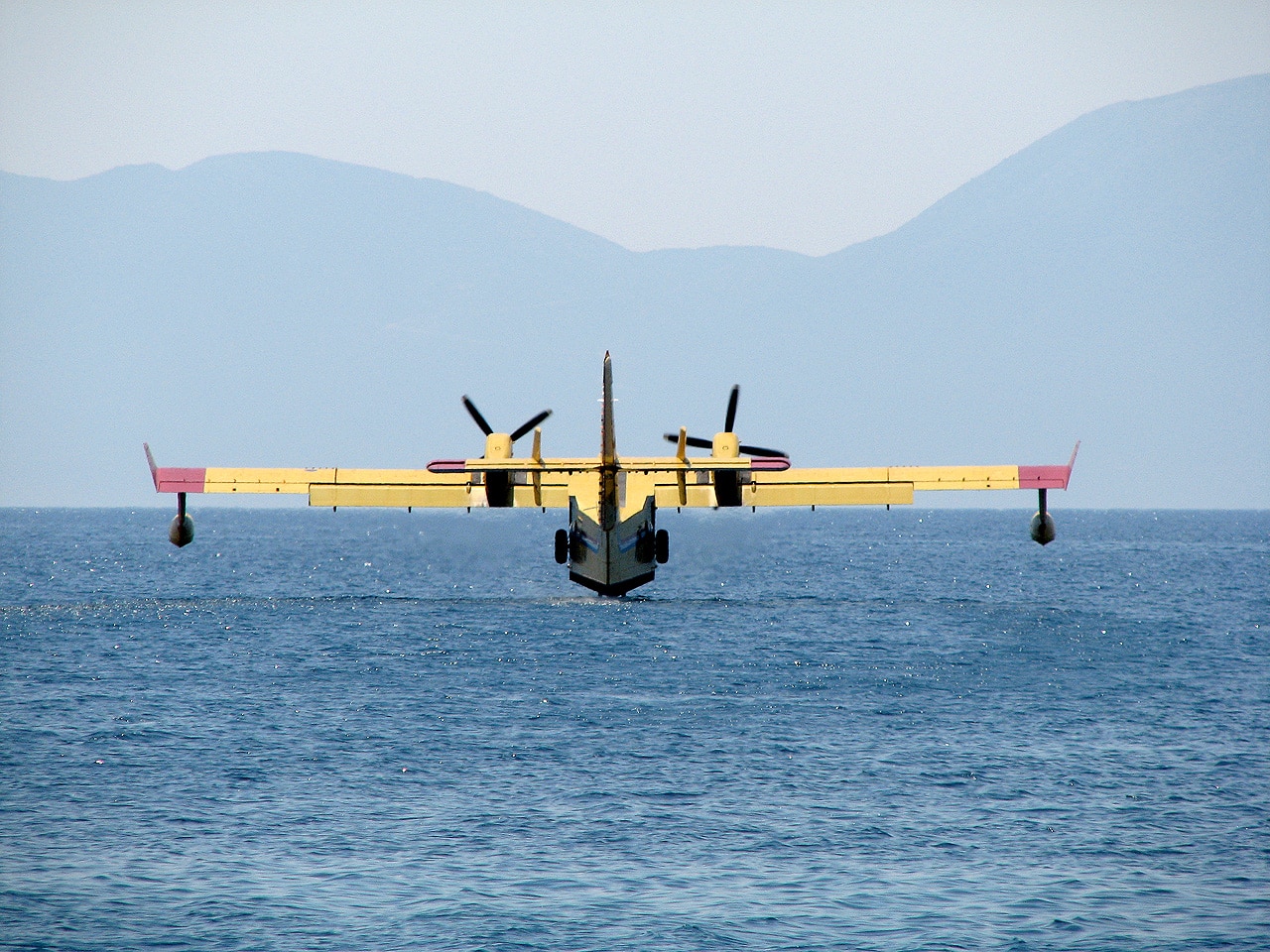
It lands on water, fills its six-tonne tanks in twelve seconds, and takes off again without ever touching the ground. The civil defence operational doctrine manual describes it as the direct-attack aircraft, the one sent directly to the heart of the blaze, particularly in coastal zones or near a body of water. Its drawback is evident in its age: an average of thirty years, an architecture dating back to the 1960s, and a six-tonne payload capacity that has become inadequate against megafires requiring far greater saturation volumes.
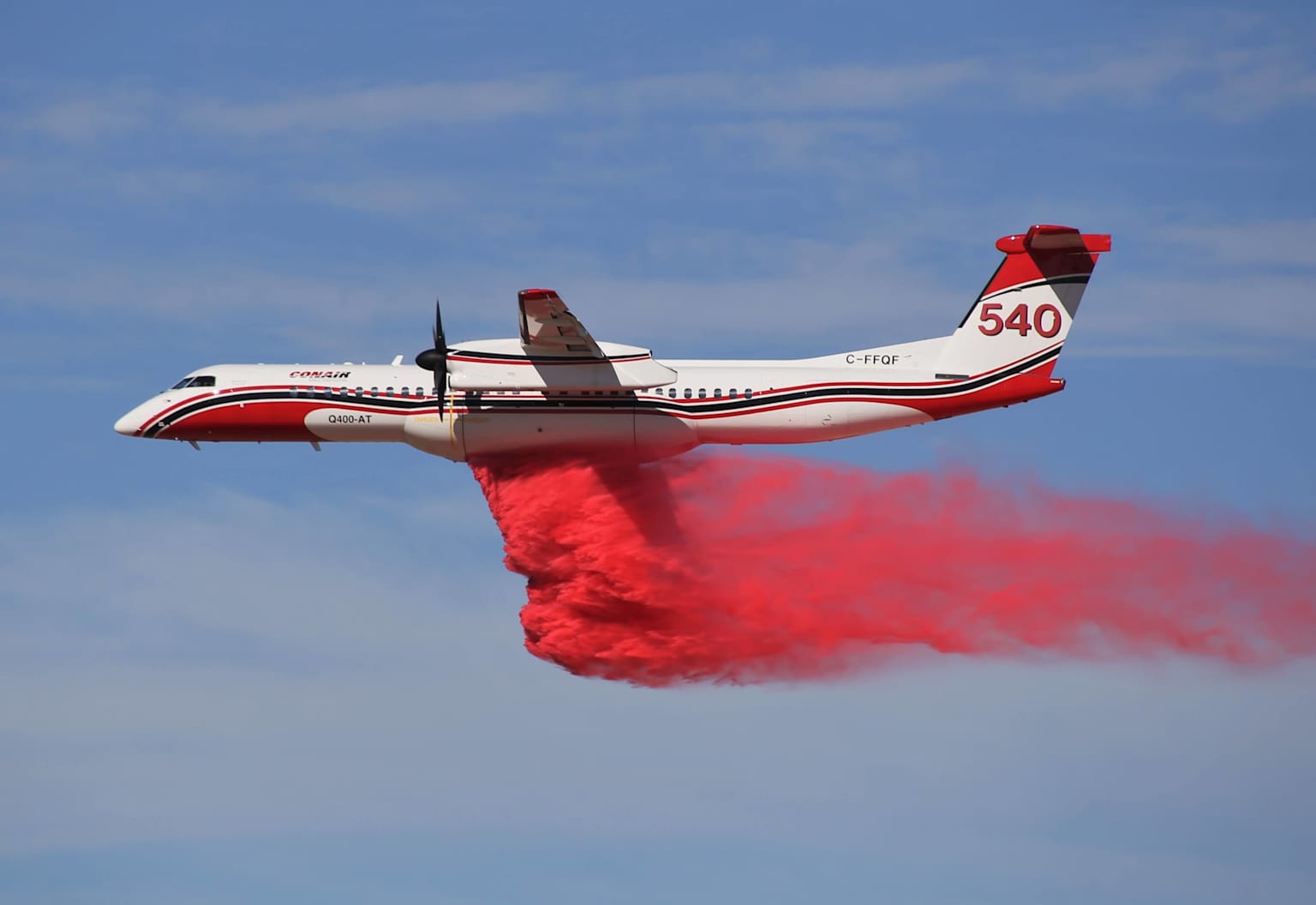
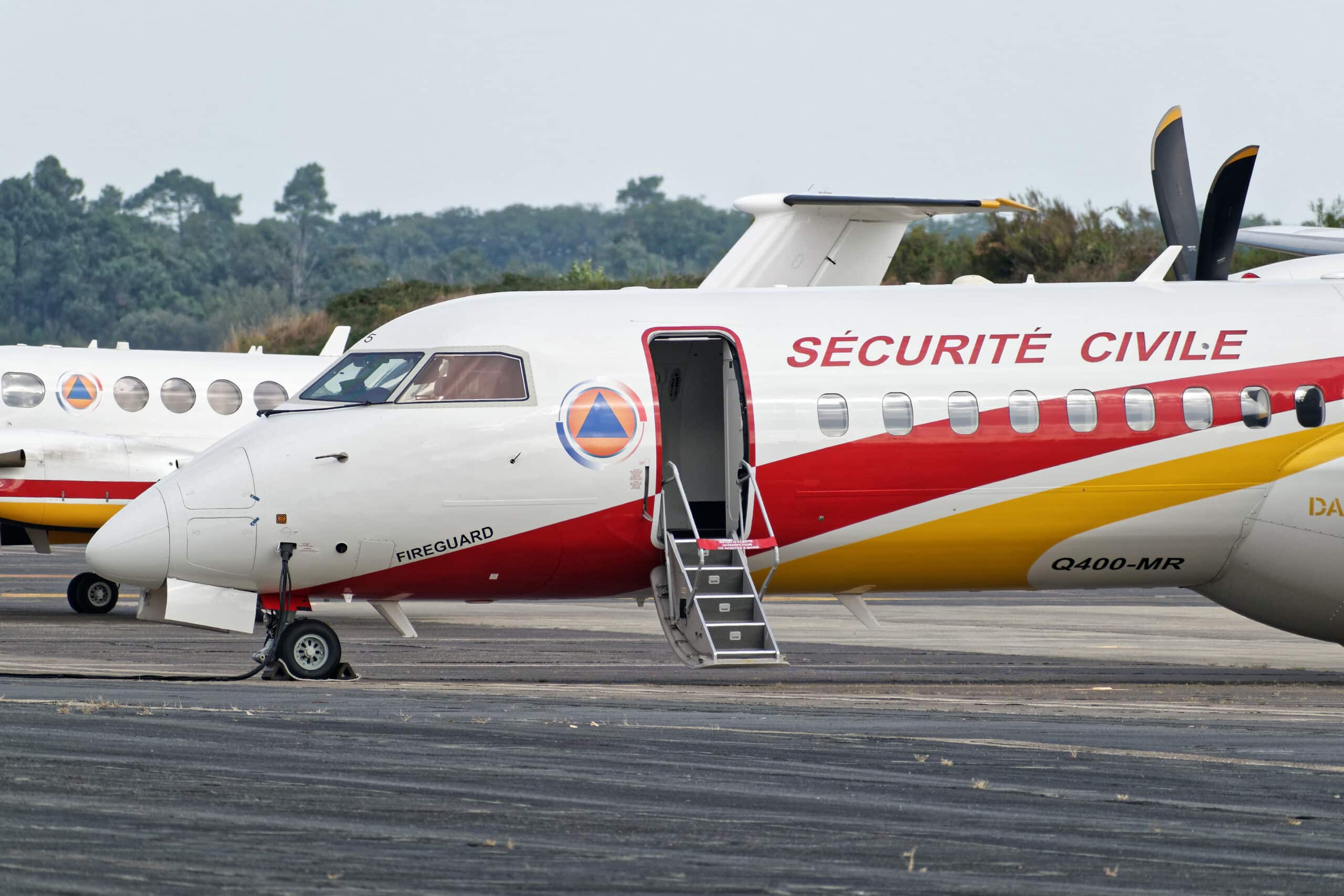
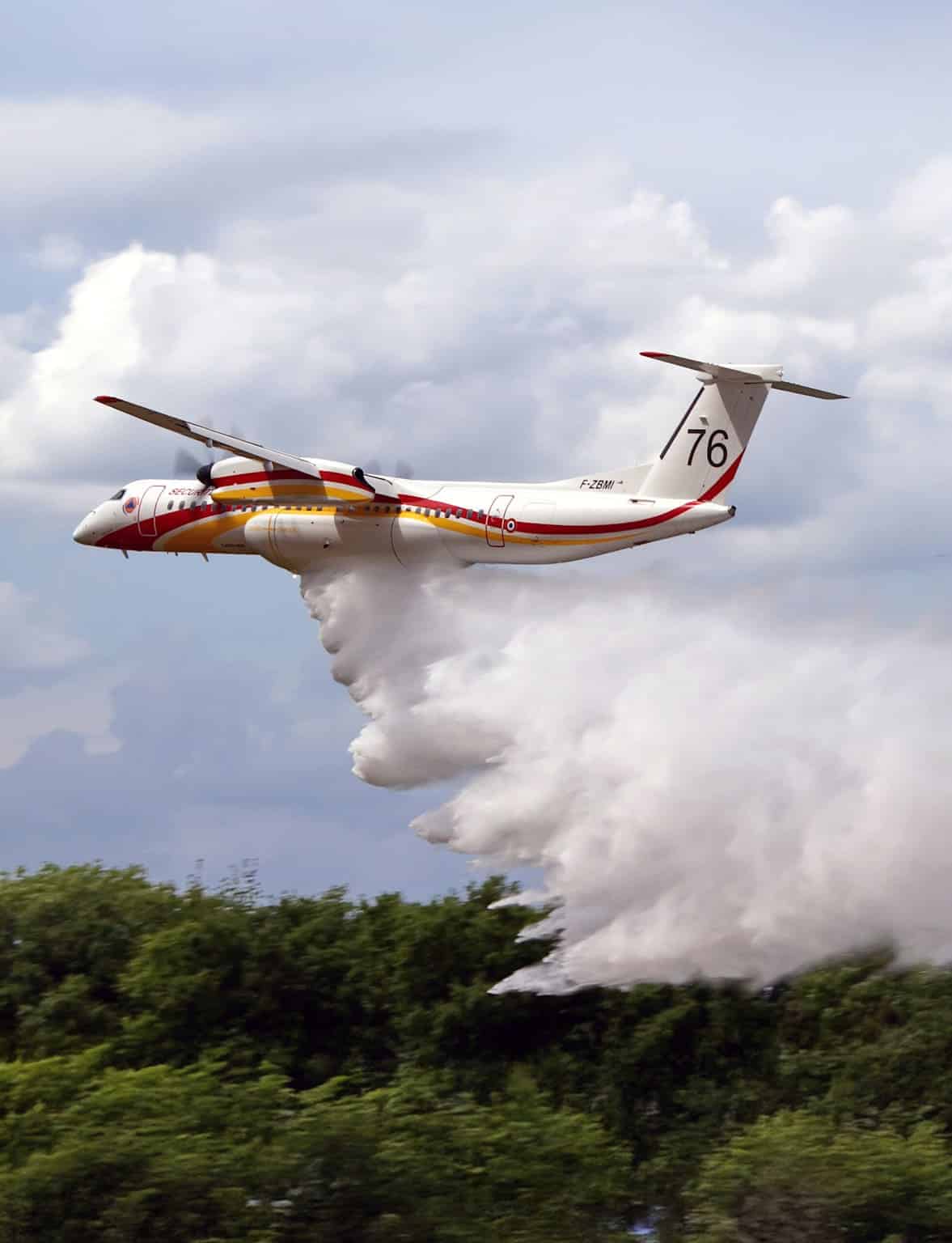
The Dash 8 Q400Dash 8 Q400
Turboprop aircraft used by the French civil defence for armed aerial patrols. Reloaded on the ground, it carries ten tonnes of retardant and covers greater distances than the Canadair. must be reloaded on the ground, which limits its tactical employment over certain terrains, but it carries ten tonnes compared to the Canadair's six, flies faster, and covers greater distances. It is the aircraft of the armed aerial patrolArmed aerial patrol (GAAr)
French doctrine of preventative aerial surveillance, where an aircraft like the Dash 8 patrols high-risk massifs, ready to drop immediately upon spotting a nascent fire, before it can escalate., a preventative watch where the aircraft patrols over high-risk massifs, ready to drop its load at the slightest sign of a fire. The doctrine manual summarises the mission in a few words that encapsulate the entire French firefighting philosophy: contain the outbreak. Prevent before fighting, rather than fighting after letting it grow.
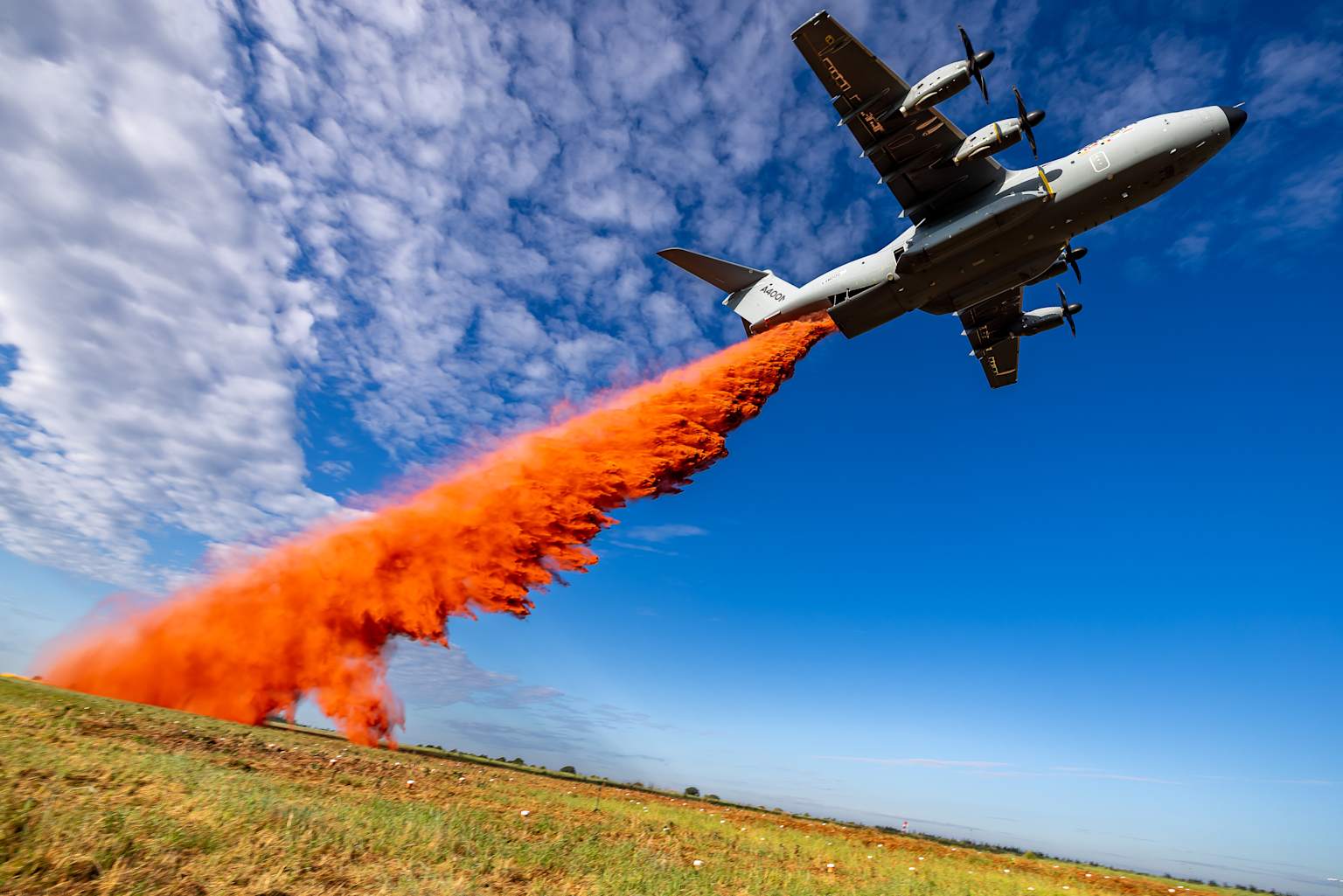
The A400M fits into neither of these logical frameworks. As a military transport aircraft fitted with an add-on kit, it can drop twenty tonnes of water in one go over a distance of four hundred metres, with a potential capacity climbing to thirty tonnes according to Airbus. The special rapporteurs of the National AssemblyNational Assembly (Maudet-Pantel report)
A parliamentary information report from July 2025 regarding the strategy for renewing the civil defence aerial fleet, based on DGSCGC data and hearings with industry representatives. were clear on this point in their July 2025 report: its use must remain occasional and reserved for megafires, because the aircraft remains, above all, a military asset whose primary vocation was never to extinguish forests.
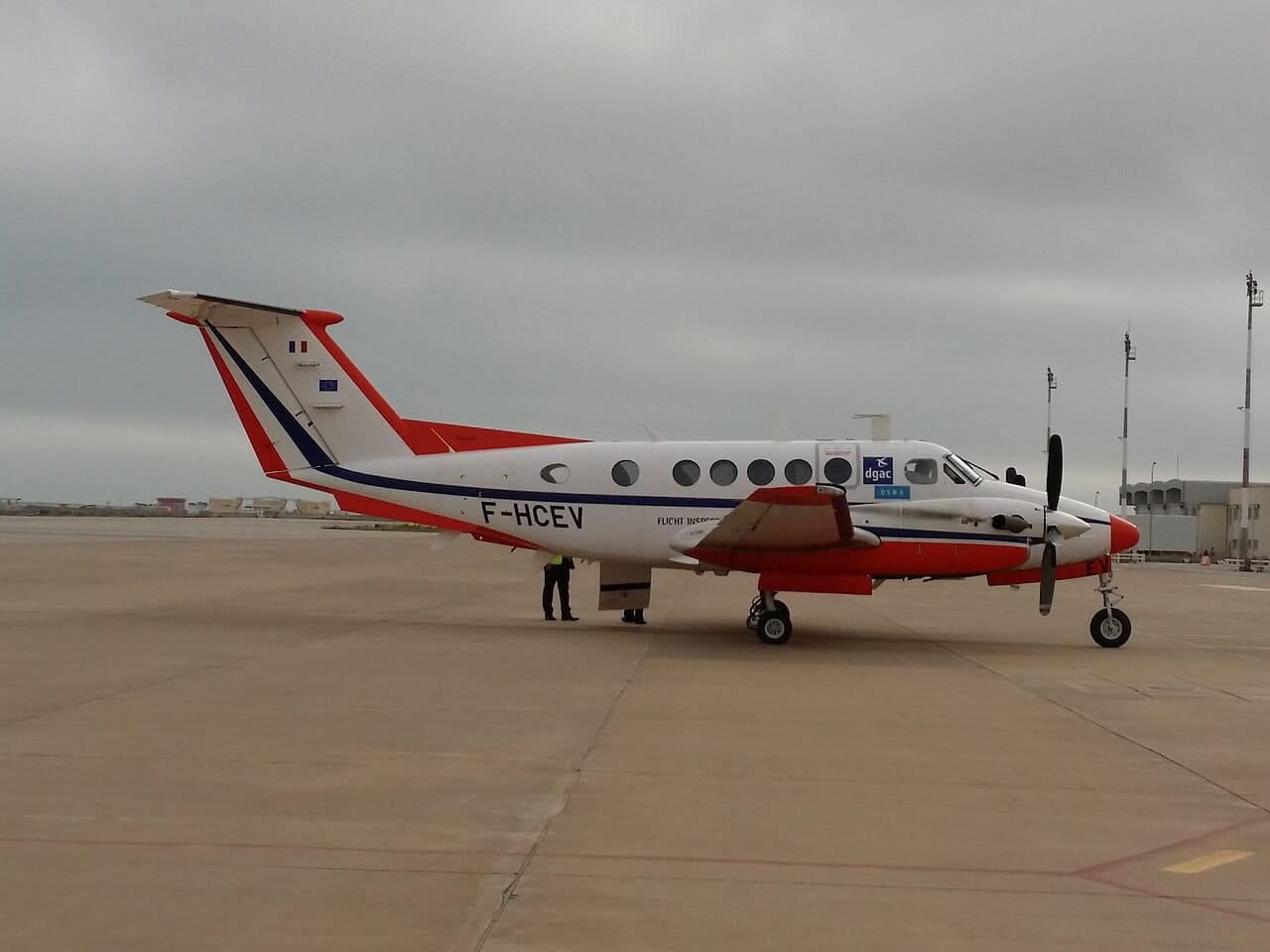
Three aircraft, three logical frameworks, and a doctrine that has ultimately come to embrace its own heterogeneity.
« Versatility is no longer merely a compromise endured for lack of a uniform fleet. It has become a pragmatic way of combining imperfect tools to cover a risk that, for its part, continues to expand. »The heterogeneous doctrine of firefighting in France
Three shortcomings documented by official reports themselves
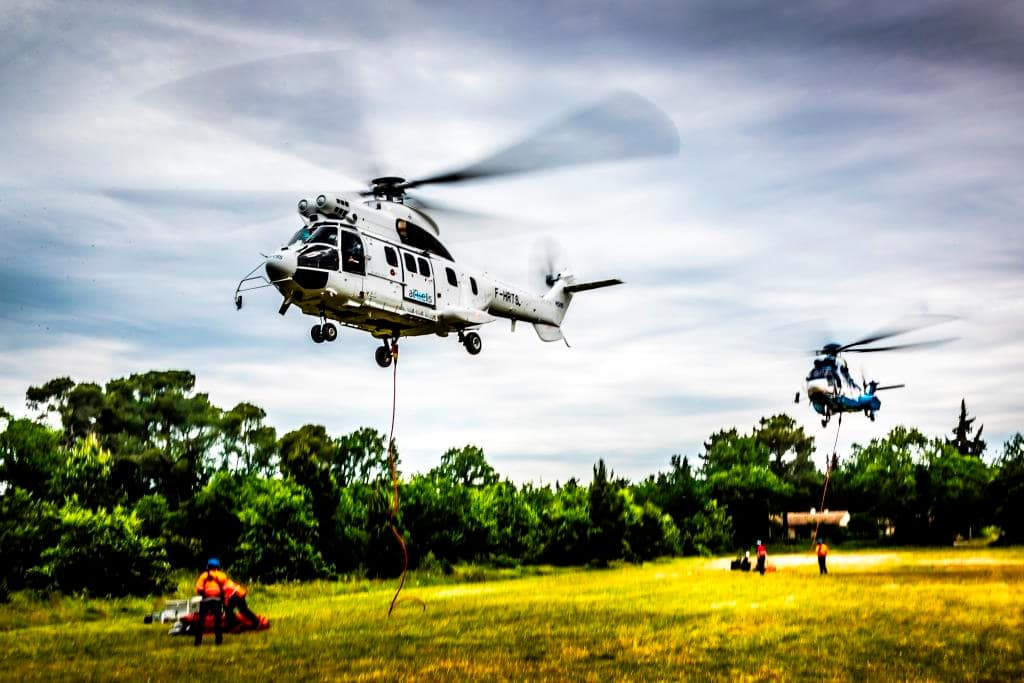
France possesses no heavy water-bombing helicoptersHeavy water-bombing helicopter
A category of helicopters capable of carrying large quantities of water, absent from the French national fleet, which must lease them each summer to supplement its capabilities.. The European Union nonetheless offered to co-finance the acquisition of two multi-mission aircraft under the RescEURescEU
The European strategic reserve of civil protection resources, established by the European Union to pool resources in response to disasters, including water-bombing aircraft and helicopters. reserve in 2024, yet France declined to position itself for this, even though it already leases up to six heavy helicopters every summer to make it through the fire season.
Furthermore, France lacks a fully operational, sovereign industrial supply chain. Projects do exist—the Frégate 100 by HynaeroHynaeroFrench enterpriseFrench company developing the Frégate 100, a sovereign water-bombing aircraft project still far from certified production....
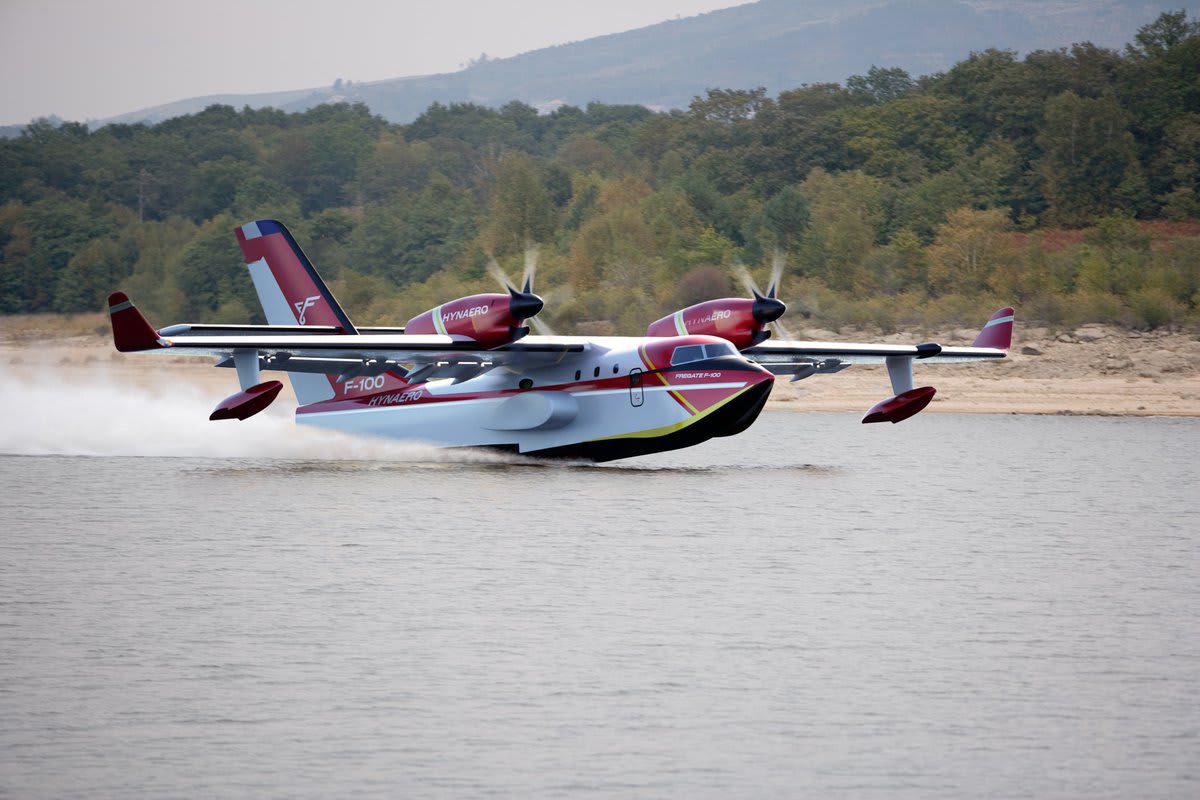
...the Kepplair 72 by Kepplair EvolutionKepplair EvolutionFrench companyCompany leading the Kepplair 72 project, a conversion of an ATR 72 into a water bomber, presented as a European industrial alternative to the Canadian monopoly., the FF72 by Positive AviationPositive AviationAerospace manufacturerIndustrialist behind the FF72 project, another prospective European water bomber supply chain currently in the development stage.—but none has reached the certified production phase, and the special rapporteurs estimate that a decade will be needed before a French or European aircraft actually rolls off an assembly line.
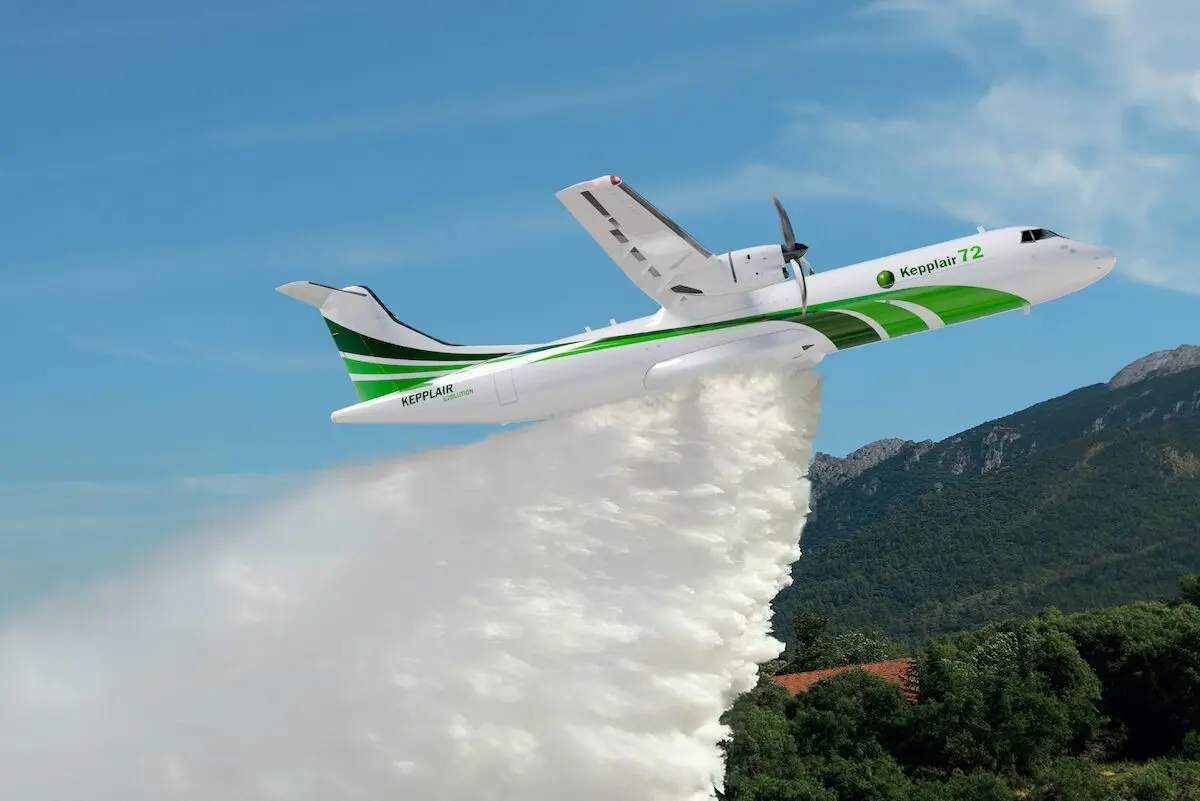
Lastly, France still has no reliable timetable for its future DHC-515s. The Canadian manufacturer's representative stated this plainly to the rapporteurs at the Paris Air Show: an order placed today would not be delivered before 2032. Airbus suggests 2030 or 2031 instead, whilst acknowledging that De Havilland Canada has already postponed its deadlines several times for an aircraft that, to date, it has never manufactured itself.
These three shortcomings stem not from an opposition party, but from institutional reports themselves. The assessment is hardly partisan when signed by a finance committee and documented by the Court of Audit. Yet, it does not tell the whole story. The other half of the tale is that of a State that eventually recommitted funds, ordered additional aircraft, and consolidated its place within the European framework. The delay is genuine. The pure inaction, however, is no longer.
The paradox
France therefore refused to co-finance two heavy helicopters via the European RescEU reserve in 2024, citing the lack of sufficient logistical infrastructure to accommodate them. That same year, it negotiated the purchase of two DHC-515s with Canada, fully aware since discussions began in 2021 that these would depend entirely on a single manufacturer, with no competitors and no backup supply chain should production cease.
Rejecting a pooled European capability in the name of fiscal prudence, whilst accepting utter dependence on a foreign supplier for the most critical tool in the entire firefighting doctrine, takes some nerve. The National Assembly's special rapporteurs essentially said as much when they raised the risk that De Havilland Canada might one day prioritise its domestic demand, amidst trade tensions, to the detriment of deliveries promised to Europe. They cite as a precedent the masks and vaccines during the pandemic—a time when France learned, to its cost, what it means to rely on a supplier with priorities other than its own.
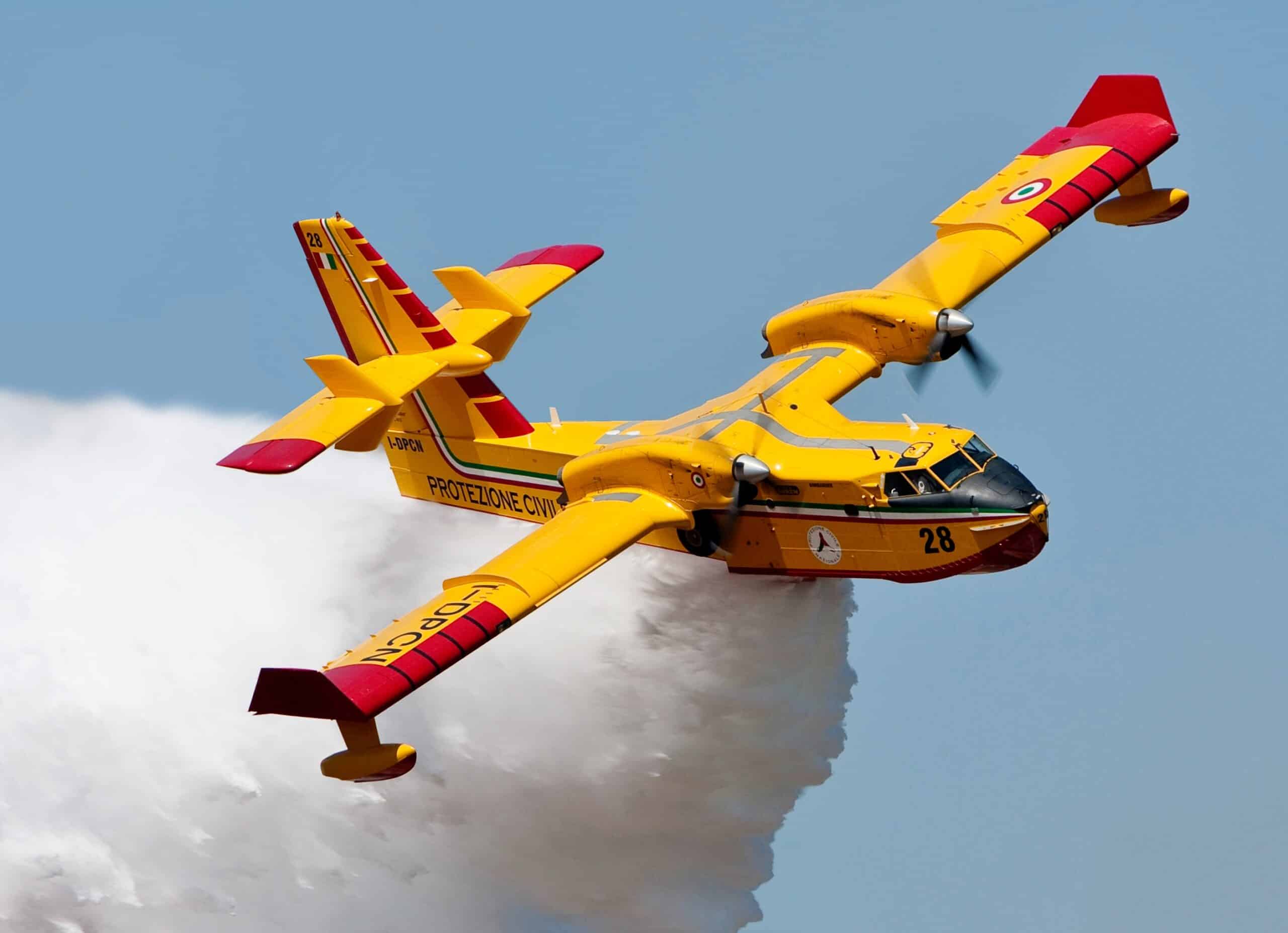
The Canadian monopoly stems primarily from the absence of any serious competitor in the global market for amphibious water bombers—a niche market comprising roughly two hundred flying boats worldwide. But enduring a dependence one has not chosen, without simultaneously investing in an already mature alternative, owes less to prudence than to a forced gamble. This is especially true for a State that otherwise champions European strategic autonomyEuropean strategic autonomy
A concept designating the European Union's capacity to act independently in areas deemed critical, notably defence and industrial capabilities, without relying on external powers. as the ultimate horizon of its defence policy.
What Nîmes-Garons brings to France
Nîmes-Garons, or LFTW to those in the know, is no ordinary airbase.
The anchor point for the entire French national fleet, it has become, since the creation of the RescEU strategic reserve in 2019, a benchmark site for the deployment of aerial assets across Southern Europe. France gains a centrality there that extends beyond its own borders, a role as a logistical hub that carries weight in European negotiations far beyond what its fleet alone would justify.
It also ranks among the main contributors to the European mechanism, providing specialised teams, strategic medical stockpiles, and now two Canadairs made available to the transitional RescEU fleet whilst awaiting the formation of a permanent reserve. This status as a contributor, rather than a mere beneficiary, gives Paris a voice that counts when the European Commission decides on the allocation of resources to the most exposed areas, from the Mediterranean basin to the Balkans.
Finally, an inertia effect works in its favour, almost without it needing to make a claim. Every euro already invested in renewing the fleet, every aircraft already ordered, every partnership already signed with a European industrialist like Hynaero or Kepplair Evolution becomes costlier for a future government to abandon than to pursue, regardless of its political leanings. In other words, the State may have taken its time to get going, but it has ultimately established a framework that is difficult to dismantle without incurring political and strategic costs.
What the departments expect, with no guarantee of receiving
In July 2025, France had to make a choice. Two territories simultaneously requested aerial assets—AudeAude
A department in southern France affected by a major megafire in 2025, which had to compete with the Bouches-du-Rhône for the allocation of limited aerial resources. and Bouches-du-RhôneBouches-du-Rhône
A French department that also requested aerial assets in July 2025, amid a shortage of available Canadairs.—and the number of available water bombers was insufficient to meet both demands at once. The episode is documented by the SenateSenate (2026 PLF budgetary report)
Report by the Senate's finance committee on the 2026 finance bill, which details the delivery schedule for the DHC-515 and documents the capability shortfall of the summer of 2025. finance committee, occurring at a time when only three out of twelve Canadairs were operational during certain critical periods of the summer of 2024.
In theory, the departments benefit from a doctrine of armed aerial patrols designed to attack incipient fires before they grow. What none of them receives, however, is the certainty that the aircraft will be available on the day a fire breaks out in their area rather than their neighbour's. The Senate budget rapporteur put it this way: the availability targets announced by the DGSCGC—98% for aircraft—appear optimistic given the observed obsolescence of the fleet.
Ultimately, these are territories absorbing the cost of a renewal delayed since 2022, without having had the slightest say in the timetable for the aircraft meant to eventually fill this gap. Yet, they are also territories that still benefit from one of Europe's most structured initial-attack doctrines, which explains why the system continues to hold up, albeit weakened, when it could have already collapsed.
Lacanau, a full-scale test
Ultimately, the choice of site was by no means accidental. The Gironde paid a heavy toll in the megafires of the summer of 2022...
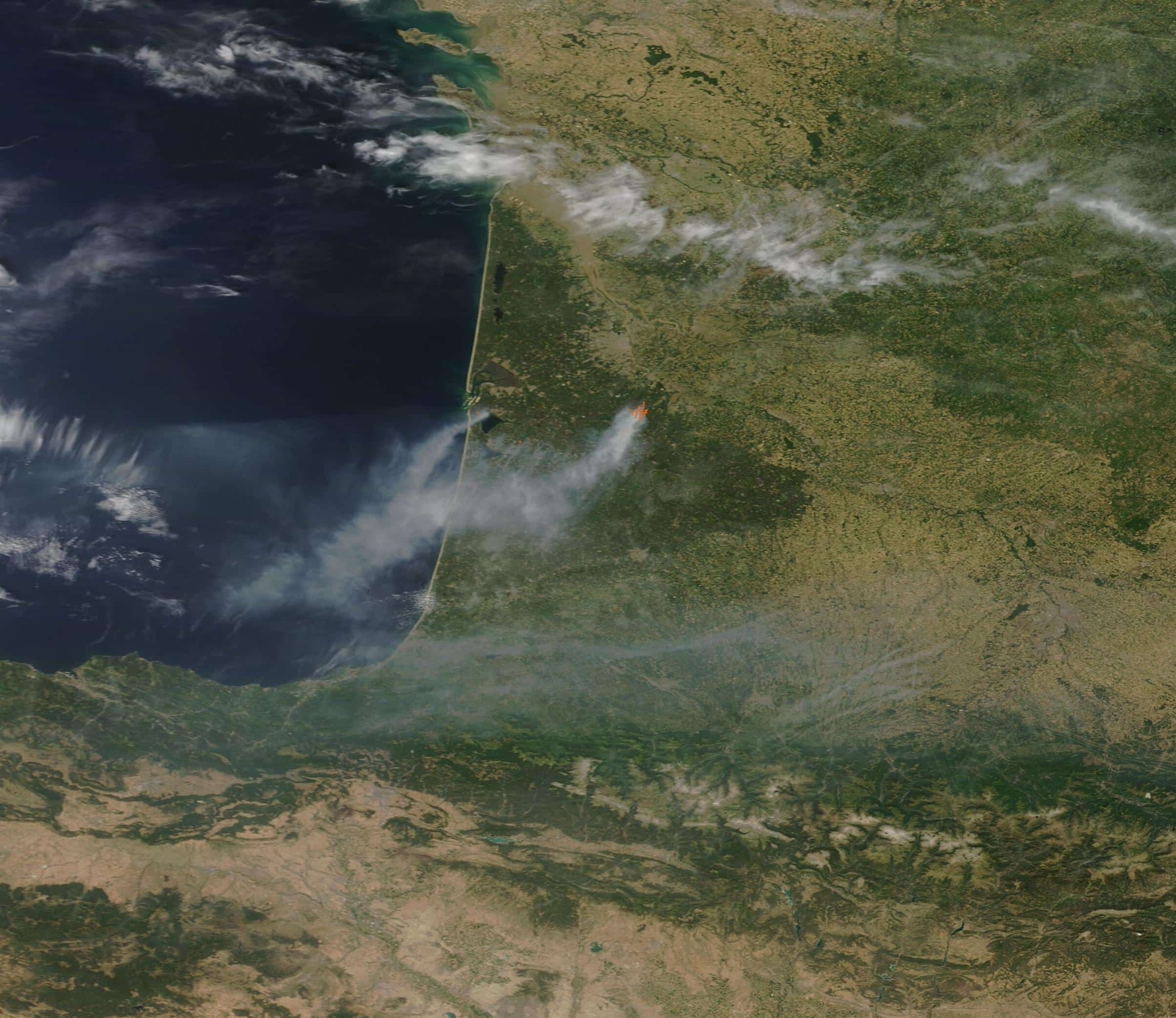
...when over 30,000 hectares of the Landes forest went up in smoke in a matter of days, forcing the evacuation of thousands of holidaymakers at the height of the tourist season. It was over this very territory, four years later, that the A400M carried out its first real-world drop under operational conditions.
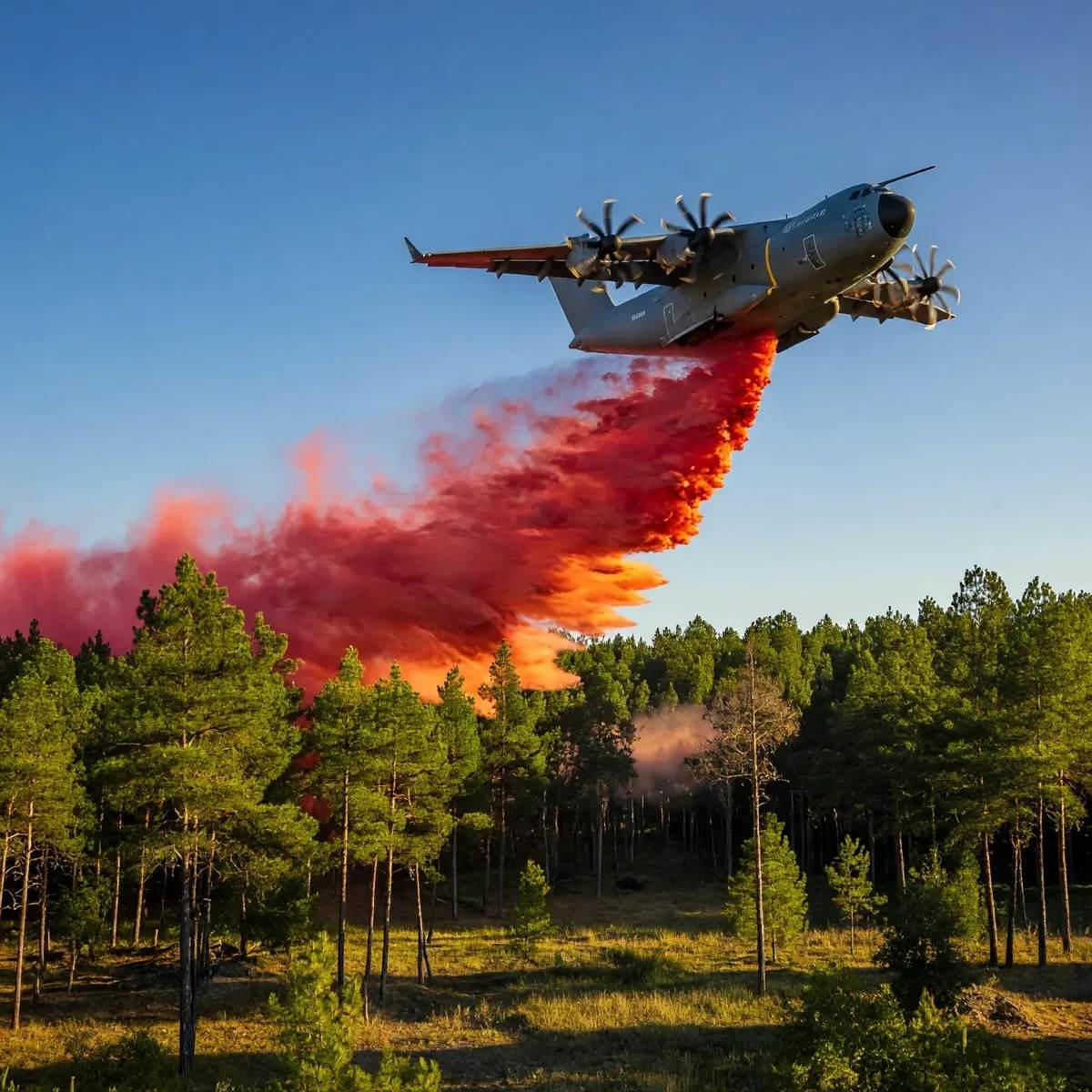
Lacanau provides a textbook case for gauging what an experimental kit can truly achieve in near-real conditions. The prototype had already been validated at Nîmes in April 2025 by the DGSCGC and the Entente ValabreEntente ValabrePublic interdepartmental establishmentInstitution responsible for research and training in civil defence and forest firefighting, partnered in the A400M kit trials in Nîmes. testing centre, but a controlled trial on neutral ground never carries the same weight as a high-pressure deployment on a fire that does not politely wait for permission. Airbus had, moreover, stated at the time of the trials: the prototype could be mobilised as early as the 2025 fire season in case of emergency, whilst the production kits would only be available at the end of 2026, provided a contract was signed swiftly.
What Lacanau reveals goes beyond the mere technical performance of a military aircraft capable of dropping twenty tonnes of water. The episode demonstrates that under maximum strain, the State can still cobble together temporary solutions, fast-track arrangements, and prevent a capability shortfall from turning into an operational dead end. It also simultaneously shows that this capacity for adaptation remains, for now, more robust than the capacity for anticipation that would have prevented the situation from arising in the first place.
The 2033 deadline
The budget passed in late 2025 for the year 2026 concurrently reveals a detail that few press outlets picked up on. The investment appropriations for Programme 161Programme 161
State budget line dedicated to civil defence, whose investment appropriations surged by over 400% in the 2026 budget, driven by the order of two additional DHC-515s financed from equity. leap by over 400% in commitment authorisations, driven by a single line item: the order of two additional water bombers, this time financed entirely from equity, without the slightest European co-financing. These two aircraft would not be delivered until late 2032 or 2033, seven to eight years after the contract's signing.
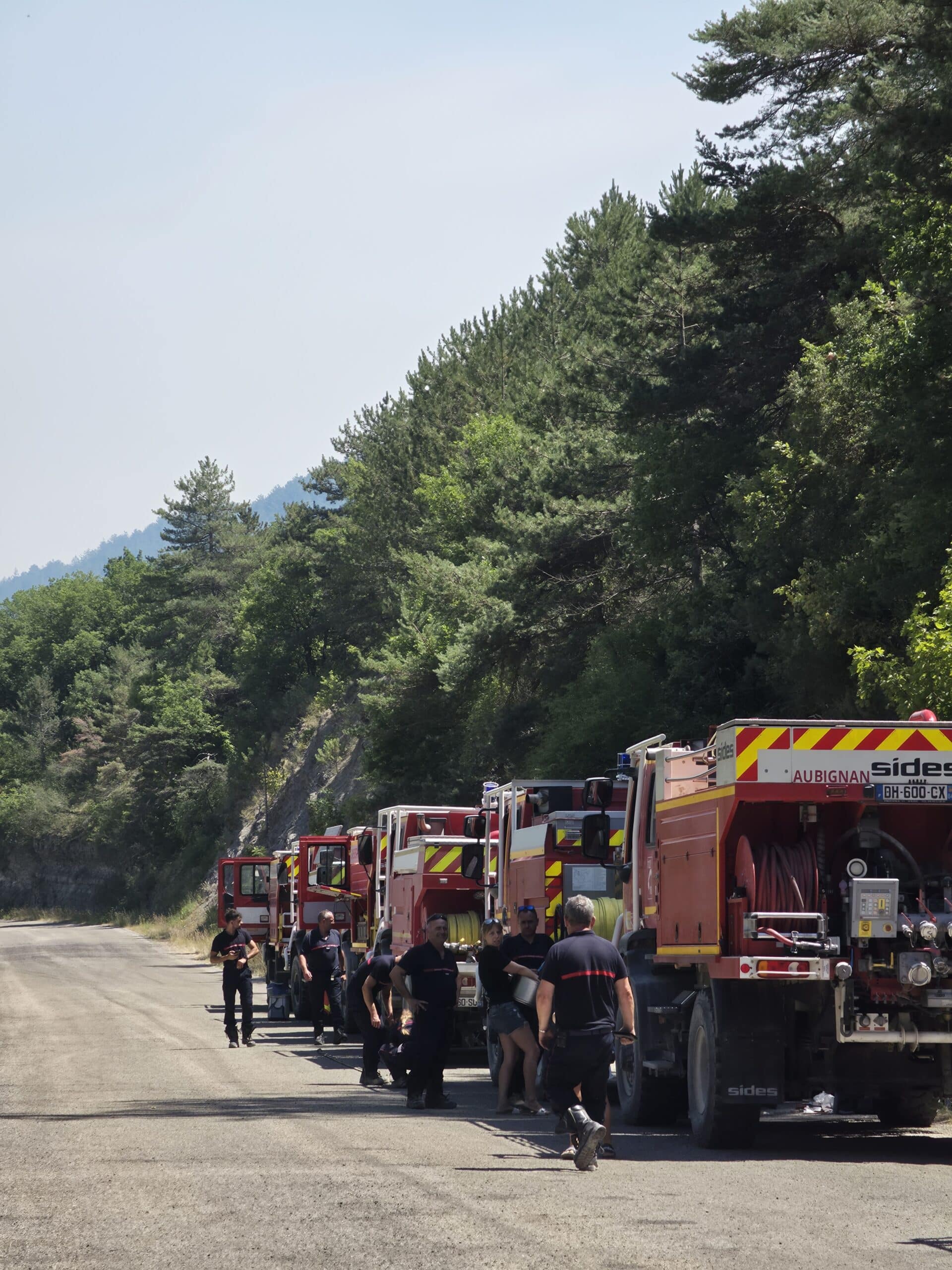
This figure encapsulates the entire trajectory of this thwarted renewal. In 2022, the presidential promise set a target of sixteen new Canadairs by 2027. In 2026, the budgetary reality acknowledges that the fleet will not reach sixteen aircraft—old and new combined—until 2033, and only if the Canadian manufacturer finally meets the production pace it has consistently failed to honour thus far. Six years now separate the speech from the contract, and the contract from the probable delivery. No government currently in office will see the complete result of its own decisions on this matter.
What Lacanau truly revealed
On 25 July 2026, therefore, France did not merely test an aircraft over Lacanau. It highlighted, without always stating it as such, the gap between an accelerating risk and public timetables that plod along at a regulatory pace: a water-bomber fleet that will not be at full strength before 2033, and a European industrial supply chain that will long remain in the planning stages.
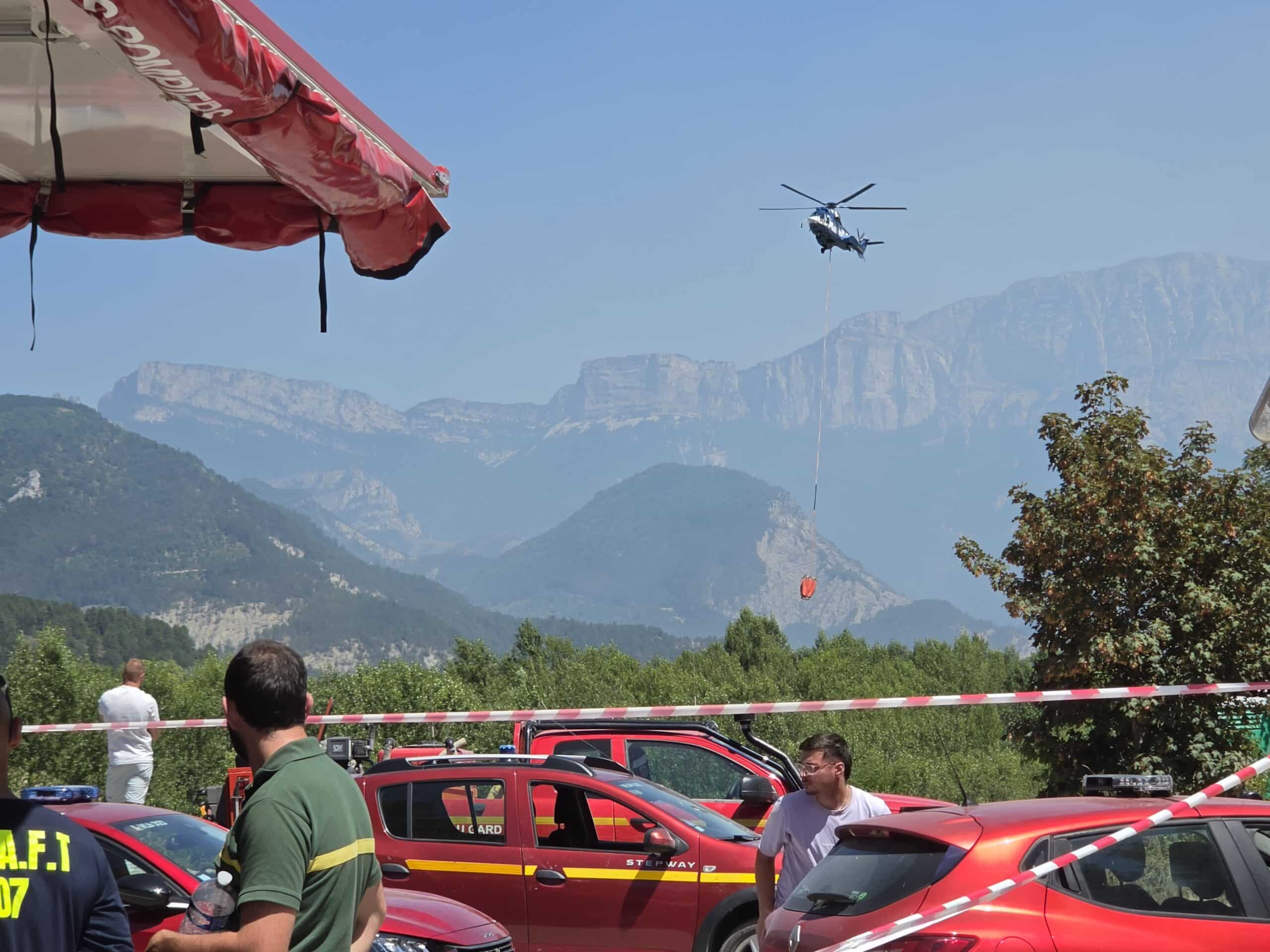
Flexible bucket suspended beneath a helicopter, filled by immersion or a pump, used to drop water on a fire. on the Die fire, Vercors. © Timothée Ravet-Salmon, photograph taken from the command post, SDIS 26, Die, 2026
The A400M proved that a country can, as a last resort, transform a warplane into a civil rescue tool. It remains to be seen whether this emergency reflex will suffice to bridge a gap that forthcoming summers will certainly not take the time to wait for.
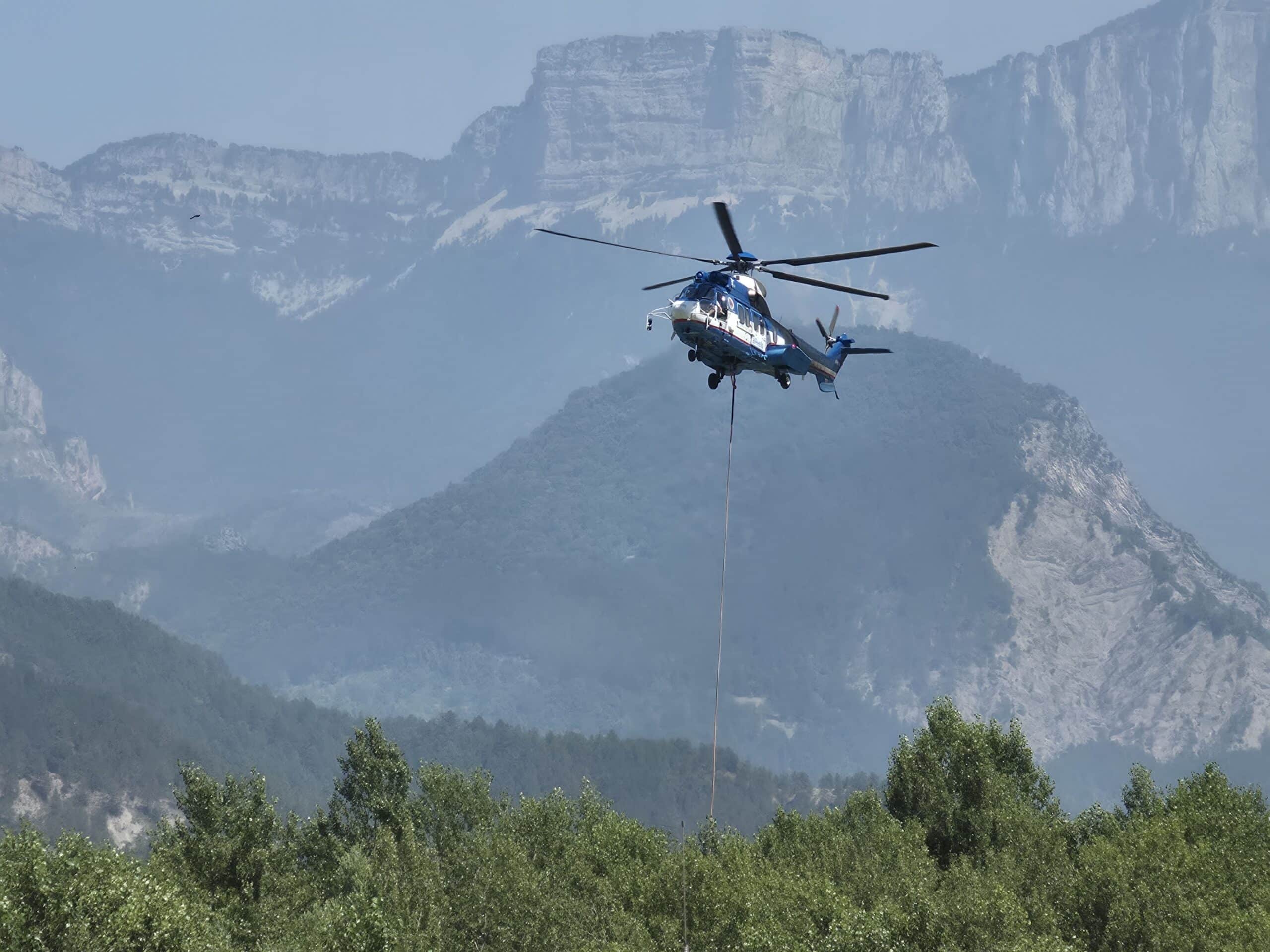
The versatility of firefighting tools testifies as much to ingenious adaptation as it does to the urgency of facing megafires that respect neither political timetables nor industrial delays.
- Information report on the strategy for renewing the civil defence aerial fleet, National Assembly, July 2025. assemblee-nationale.fr
- Opinion on the 2026 Finance Bill (Civil Defence), Senate, 2025. senat.fr
- Court of Audit referral on the civil defence aerial fleet, 2022. ccomptes.fr
- Operational communications from Airbus Defence and Space on the A400M kit. airbus.com